

CTC vs in-hand salary: why ₹12 lakh CTC is about ₹85,000 a month
A ₹12 lakh offer is ₹1 lakh a month on paper and about ₹85,400 in the bank. Here is where the other ₹14,600 goes, line by line, and which parts you can actually change.
Calci Editorial · · 5 min read
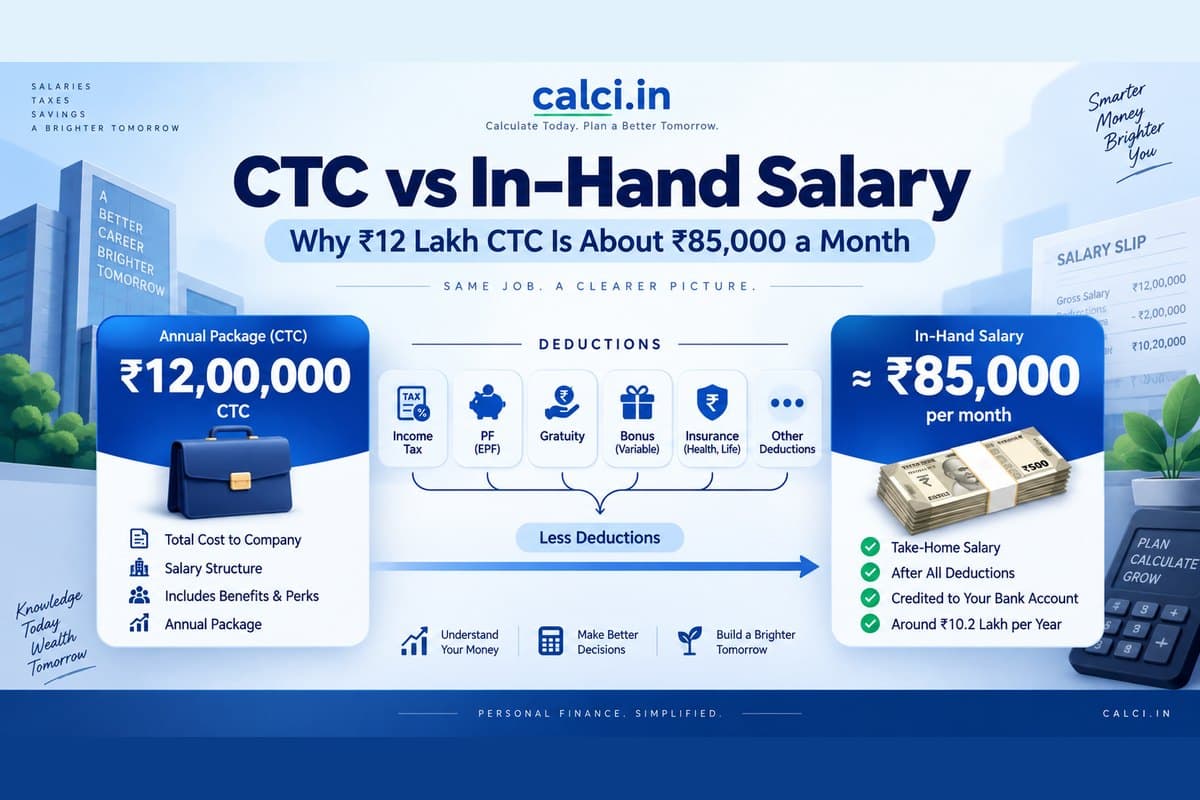
The offer letter says ₹12,00,000. Divide by twelve and it is a round ₹1,00,000 a month.
The first salary slip says ₹85,396.
Nobody lied. CTC means cost to company — what the employer spends on you in a year — and a good chunk of that spending was never going to arrive as salary.
Two slices that never reach your salary at all
On a ₹12 lakh CTC with basic pay at half, two amounts are taken out before anything is called salary.
The employer's PF contribution. 12% of basic. On ₹6,00,000 of basic that is ₹72,000 a year. It goes into your provident fund, so it is yours — just not this month.
Gratuity. Many employers show the gratuity they set aside as part of CTC. Fifteen days' basic for each year, on a 26-day month, is 4.81% of annual basic: ₹28,846.
Take those out and the actual gross salary is ₹10,99,154.
Three more that come off what is paid
| A year | A month | |
|---|---|---|
| CTC | ₹12,00,000 | ₹1,00,000 |
| Employer PF | −₹72,000 | −₹6,000 |
| Gratuity | −₹28,846 | −₹2,404 |
| Gross salary | ₹10,99,154 | ₹91,596 |
| Your own PF | −₹72,000 | −₹6,000 |
| Professional tax | −₹2,400 | −₹200 |
| Income tax, new regime | ₹0 | ₹0 |
| In hand | ₹10,24,754 | ₹85,396 |
Your own PF matches the employer's, 12% of basic.
Professional tax is a state tax. Not every state levies it, and the Constitution caps it at ₹2,500 a year, so it is never more than a couple of hundred rupees a month.
Income tax is zero here. Under the new regime a salaried person gets a ₹75,000 standard deduction, and taxable income up to ₹12 lakh pays no tax after the rebate. ₹10,99,154 less ₹75,000 is comfortably under that.
So the ₹14,604 a month that went missing is mostly PF — both halves of it. That is savings, not loss. But it is not spending money either, and a budget built on ₹1 lakh a month will fail in the first week.
Basic pay is the lever nobody asks about
PF and gratuity are both worked out on basic pay. So the share of CTC called "basic" quietly decides the monthly figure.
| Basic, as % of ₹12 lakh CTC | In hand a month | Your PF a year |
|---|---|---|
| 30% | ₹91,158 | ₹43,200 |
| 40% | ₹88,277 | ₹57,600 |
| 50% | ₹85,396 | ₹72,000 |
| 60% | ₹82,515 | ₹86,400 |
A higher basic lowers take-home pay and raises what builds up in PF and gratuity. Neither is wrong. It is a choice between money now and money later, made by whoever designed the salary structure.
Worth knowing: the new labour codes define wages as at least half of total pay, which is pushing many employers towards a higher basic. If your structure changed and the monthly figure dropped, that is probably why.
The PF wage ceiling
EPF contributions can legally be calculated on a wage of just ₹15,000 a month instead of your full basic. Some employers offer that option; many do not.
On the same ₹12 lakh CTC:
| PF worked out on | Your PF a year | In hand a month |
|---|---|---|
| Full basic | ₹72,000 | ₹85,396 |
| ₹15,000 ceiling | ₹21,600 | ₹93,796 |
₹8,400 a month more to spend, and ₹1 lakh a year less going into retirement savings between the two contributions. For someone with a home loan EMI to service, that can be a sensible trade. For someone with no other retirement plan, it usually is not.
Where income tax starts to bite
Below ₹12 lakh or so of CTC, the gap between CTC and take-home is almost entirely PF, gratuity and professional tax. Above it, tax arrives quickly.
| CTC | In hand a month | Income tax a year | In hand, as % of CTC |
|---|---|---|---|
| ₹6,00,000 | ₹42,598 | ₹0 | 85.2% |
| ₹9,00,000 | ₹63,997 | ₹0 | 85.3% |
| ₹12,00,000 | ₹85,396 | ₹0 | 85.4% |
| ₹15,00,000 | ₹1,00,309 | ₹77,835 | 80.2% |
| ₹20,00,000 | ₹1,29,340 | ₹1,57,440 | 77.6% |
| ₹25,00,000 | ₹1,56,136 | ₹2,63,875 | 74.9% |
| ₹40,00,000 | ₹2,28,211 | ₹6,82,920 | 68.5% |
All on the new regime, basic at half, full PF.
The jump from ₹12 lakh to ₹15 lakh is the one that surprises people. CTC rises by 25%. Take-home rises by about 17.5%, because taxable income crosses the rebate limit and tax on the whole slab structure appears.
Bonuses and variable pay
"Variable" in a CTC is usually shown at 100% of target. What gets paid depends on ratings and company results, and it arrives once a year, not monthly.
It also gets taxed at the margin, which can be brutal around the rebate limit. A ₹15 lakh CTC that includes ₹1,50,000 of variable pay:
- monthly take-home on the fixed part is ₹94,295;
- the fixed part alone stays under the rebate limit, so it pays no tax;
- the bonus pushes the year over the line and carries all ₹77,835 of the tax — you keep ₹72,165 of it.
Over half of that bonus goes in tax. That is not a slab rate; it is the rebate disappearing.
Does the old regime change the picture?
Often, no. On a ₹20 lakh CTC with PF counted under 80C and another ₹2.5 lakh of deductions — HRA exemption, health insurance and so on — the old regime pays ₹1,22,063 a month against ₹1,29,340 under the new one. That is ₹7,277 a month in favour of the new regime, even with a fairly generous set of deductions.
Run both on your own numbers before assuming either way.
Reading your offer letter
Before comparing two offers, find out:
- Basic as a share of CTC. It moves take-home by thousands a month.
- PF on full basic or the ₹15,000 ceiling.
- Whether gratuity is included in CTC.
- How much is variable, and what it paid last year.
- One-time items — joining bonus, relocation — which inflate first-year CTC and vanish in year two.
- Insurance premiums folded into CTC that you never see as cash.
Two offers with the same CTC can differ by ₹10,000 a month in hand. Two offers ₹1 lakh apart can pay the same.
Where these numbers come from
Two of the deductions in this post are set by rule rather than by your employer, and both are worth checking at source rather than taking from a salary calculator — yours or anyone else's.
The provident fund contribution rate, the wage ceiling it applies to and the rules on voluntary contributions are published by the Employees' Provident Fund Organisation. The income tax slabs, the standard deduction and the rebate that decide the tax line are on the Income Tax Department's portal, which is also where the current year's figures appear first when a Budget changes them.
If a number in your offer letter disagrees with one of those two, the offer letter is the one that is wrong.
The in-hand salary calculator turns any CTC into monthly take-home pay with your basic percentage, PF option, variable pay and tax regime. To compare the two regimes in detail, use the income tax calculator. If you pay rent, the HRA exemption calculator shows what the old regime would let you claim, and the salary hike calculator shows what a raise is worth once inflation has had its share.