

Gratuity under the new labour codes: the 1-year rule, 15/26 formula and ₹20 lakh cap
Five years is no longer the rule for everyone. Fixed-term staff now qualify after one, a low basic salary can no longer shrink the payout, and one extra day of service can be worth ₹23,077.
Calci Editorial · · 5 min read
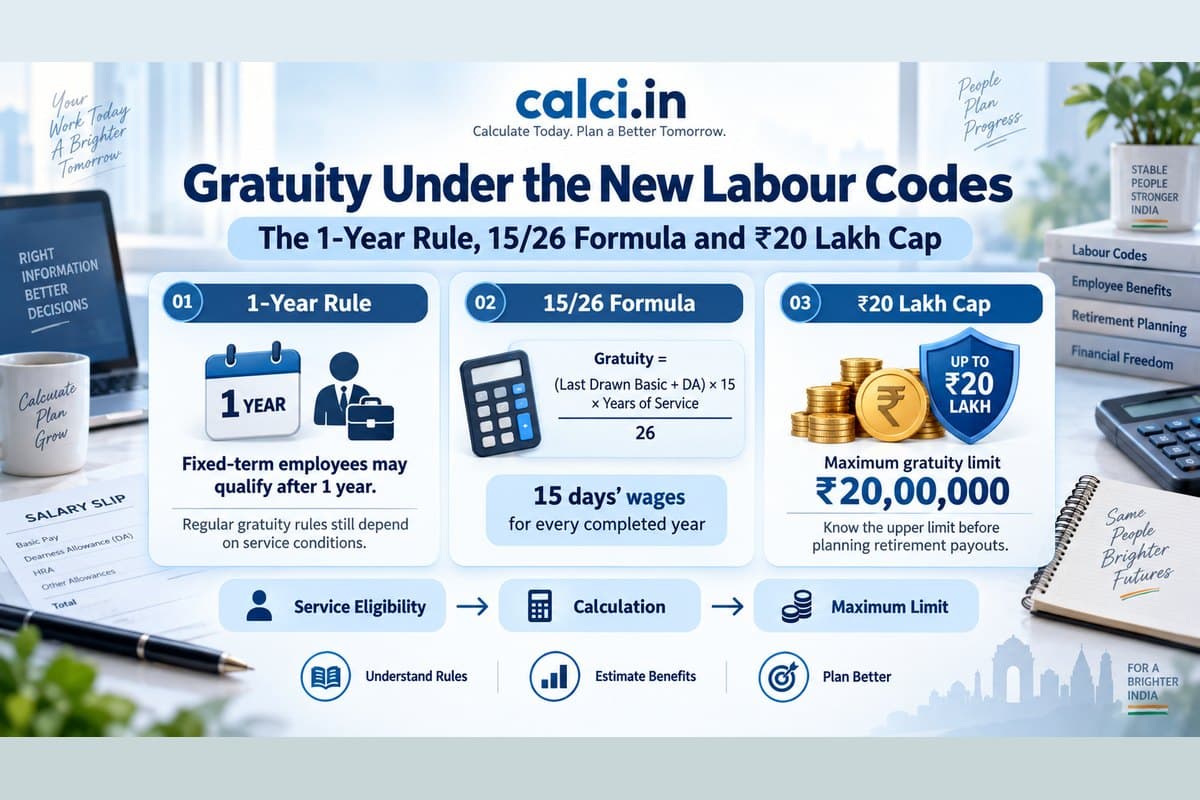
Every HR induction in India says the same sentence: "No gratuity before five years."
Until recently it was simply true. It is now only half true — and the half that changed matters to a lot of contract workers.
What changed on 21 November 2025
The Code on Social Security, 2020 came into force on 21 November 2025, along with the other labour codes. It replaced the Payment of Gratuity Act, 1972.
Three things carried over almost untouched:
- the formula, fifteen days' wages for every year of service;
- the ₹20 lakh ceiling on what an employer must pay;
- five years of continuous service for a permanent employee.
Three things are new or sharper:
- Fixed-term employees qualify after one year, with gratuity paid pro rata to their service.
- "Wages" cannot be squeezed. When the allowances left out of wages add up to more than half of total pay, the excess counts as wages.
- Payment is due within 30 days of becoming payable, with interest if the employer is late.
The formula, and why it divides by 26
For an employer covered by the law:
Gratuity = last drawn wages × 15 × years of service ÷ 26
"Wages" here means basic pay plus dearness allowance. The 26 is the number of working days the law assumes in a month, so 15 ÷ 26 of a month's wages is fifteen days' pay.
Someone on ₹40,000 basic plus DA earns ₹23,077 of gratuity for every year counted. After seven years and eight months:
| Wages | Service | Years counted | Gratuity |
|---|---|---|---|
| ₹40,000 | 7 years 8 months | 8 | ₹1,84,615 |
Eight years, not seven. That is the rounding rule, and it is worth a proper look.
One day that is worth ₹23,077
A part-year of service in excess of six months counts as a full year. Exactly six months does not.
| Last working day | Service | Years counted | Gratuity |
|---|---|---|---|
| 30 June 2024 | 6 years 6 months 0 days | 6 | ₹1,38,462 |
| 1 July 2024 | 6 years 6 months 1 day | 7 | ₹1,61,538 |
Same person, same ₹40,000, joined 1 January 2018. Leaving one day later is worth ₹23,077.
If you are resigning and your service is sitting right on six months past an anniversary, check the date before you agree it. It is the cheapest raise you will ever negotiate.
This rounding applies to employers covered by the law. An employer outside it that pays gratuity by its own policy is taxed on a different basis — half a month's average salary for each completed year, so 15 ÷ 30 and no rounding up. On the same ₹40,000 and seven years eight months, that works out to ₹1,40,000 instead of ₹1,84,615.
The 50% rule that ends the low-basic trick
For years, a common salary structure kept basic pay low and loaded the rest into allowances. Low basic meant low PF and low gratuity.
The Code closes that off. If what is excluded from wages is more than half of total remuneration, the excess is added back into wages. In practice, wages for gratuity cannot fall below half of total pay.
Here is what that does to ten years of service on ₹1,00,000 a month of total pay with a ₹30,000 basic:
| Wages used | Gratuity for 10 years |
|---|---|
| Basic only, ₹30,000 | ₹1,73,077 |
| Half of total pay, ₹50,000 | ₹2,88,462 |
A difference of ₹1,15,385, from a definition.
This is also why a lot of employers have been reworking salary structures since the codes arrived. A higher basic raises gratuity and PF, which come out of the same CTC — so the monthly take-home can dip even though nothing about the job changed.
Who qualifies, and when the five years do not apply
| Situation | Minimum service |
|---|---|
| Permanent employee, resigning or retiring | 5 years |
| Fixed-term employee | 1 year |
| Death or disablement | None |
The last line is easy to miss and it matters. Take someone with four years and eleven months of service on ₹40,000:
- if they resign, the five-year rule as written means nothing is payable;
- if the employment ends because of death or disablement, the gratuity is paid — ₹1,15,385, with the eleven months rounding up to a fifth year.
For a fixed-term contract, one year of service on ₹35,000 earns ₹20,192. A contract that ends at ten months earns nothing, because the one-year threshold was not reached.
The ₹20 lakh cap, and the tax
The formula has no ceiling. The payment does.
Someone on ₹2,50,000 basic with fifteen years of service reaches ₹21,63,462 by the formula. The employer's obligation stops at ₹20,00,000.
On the tax side, gratuity received by a private-sector employee is exempt up to ₹20 lakh. That limit is for all the gratuity you receive over your working life, not per employer, so a second large payout later can be taxable even if the first one was not. Gratuity paid to government employees is fully exempt.
Anything paid above the exempt limit is taxed as salary in the year you receive it.
Checking your own number
You need four things: your joining date, your last working day, your last drawn basic plus DA, and your total monthly pay.
- Count your service to the day, including the last working day.
- Round up only if the part-year is more than six months.
- Take the higher of basic plus DA, or half of your total monthly pay.
- Multiply wages by 15, by the years counted, and divide by 26.
- Compare with ₹20 lakh.
If the number HR gives you is lower, the most common reasons are the rounding date and the wages definition. Both are worth asking about in writing.
Where these rules come from
Gratuity is statutory, so none of it is a matter of company policy — and the rules changed recently enough that a lot of published guidance is still describing the old Act.
The Code on Social Security, 2020 and the other labour codes, including the dates they came into force, are on the Ministry of Labour and Employment's labour codes page. The text of the code itself is on India Code, the government's repository of central legislation, which is the place to check the exact wording of the continuous-service and wages definitions rather than a summary of them.
If your employer's calculation differs from the code, ask which provision it is relying on, in writing.
The gratuity calculator does all five steps from your dates and pay, including the six-month rounding and the 50% wages rule. To see gratuity alongside the PF you will have built by retirement, use the PF and gratuity calculator. And because gratuity sits inside your CTC, the in-hand salary calculator shows how much of an offer actually reaches your account each month.