

How EMI is calculated: the formula behind your loan installment
The bank quotes one number and never shows the working. Here is the formula, what each piece does, and why your first year barely touches the loan.
Calci Editorial · · 6 min read
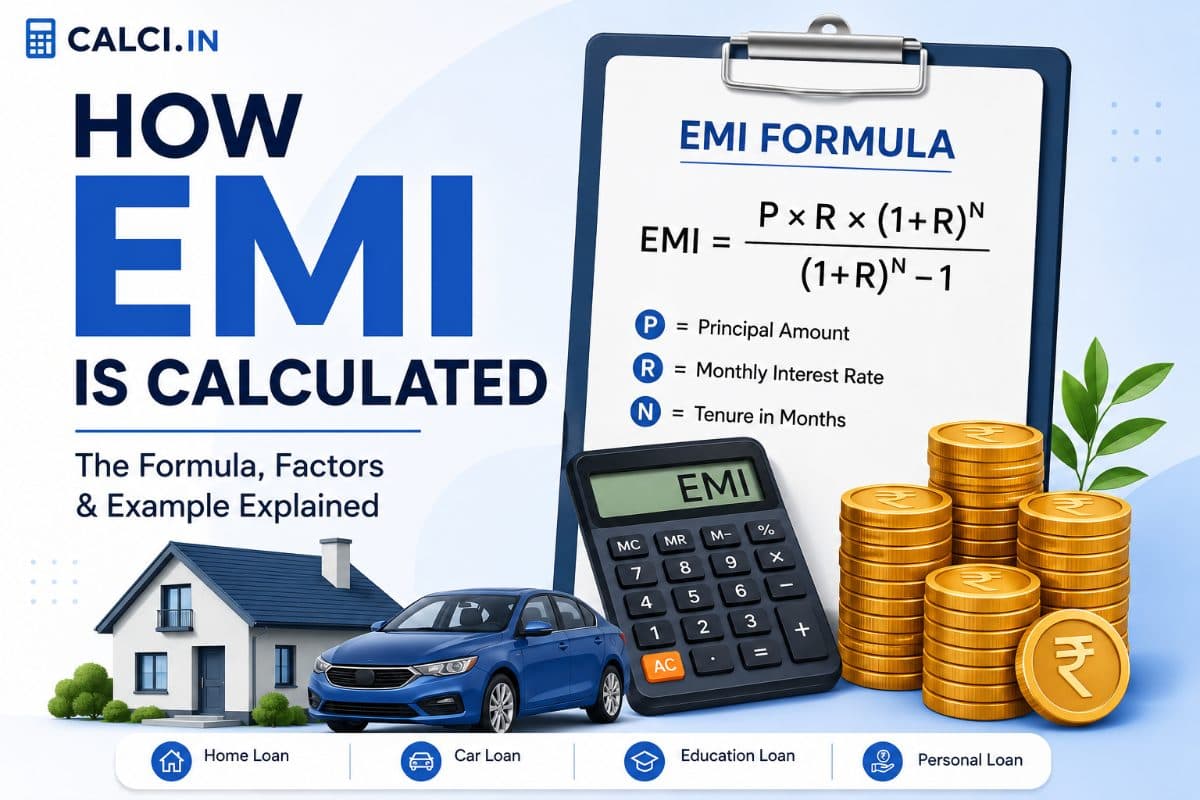
The loan officer types your numbers into something, turns the screen slightly, and says "twenty-six thousand two hundred and twenty-five".
Nobody ever shows you where that came from.
It is not a secret and it is not complicated. One formula, three inputs, and a result that explains a lot about why loans feel the way they do.
The formula
EMI = P × i × (1 + i)ⁿ ÷ ((1 + i)ⁿ − 1)
P is what you borrowed. n is the number of months. i is the monthly interest rate — and this is the part people get wrong, because it is the annual rate divided by 12 and then by 100. An 8.6% loan has i = 0.0071667.
Take a ₹30,00,000 home loan at 8.6% for 20 years. Put it through and you get ₹26,225 a month.
Over 240 months that is ₹62,93,972. You borrowed thirty lakh and you will hand back nearly sixty-three.
Sit with that for a second, because it is the whole reason the rest of this post exists.
Every payment is two payments
The EMI never changes. What is inside it changes every single month.
Tip: The EMI calculator prints the full month-by-month split, so you can see the exact month principal finally overtakes interest.
Each installment first pays the interest that built up on whatever you still owe. Whatever is left over — and only that — reduces the loan.
Month one on this loan:
- Interest: ₹30,00,000 × 8.6% ÷ 12 = ₹21,500
- Principal: ₹26,225 − ₹21,500 = ₹4,725
You paid ₹26,225 and your loan went down by four and a half thousand rupees.
Here is how the split moves:
| Month | Interest | Principal | Still owed |
|---|---|---|---|
| 1 | ₹21,500 | ₹4,725 | ₹29,95,275 |
| 12 | ₹21,114 | ₹5,111 | ₹29,41,012 |
| 60 | ₹19,024 | ₹7,201 | ₹26,47,347 |
| 120 | ₹15,173 | ₹11,052 | ₹21,06,058 |
| 180 | ₹9,261 | ₹16,964 | ₹12,75,234 |
| 240 | ₹187 | ₹26,038 | ₹0 |
After a full year — ₹3,14,700 paid — the loan has shrunk by ₹58,988.
Eighty-one percent of your first year was interest.
And look at month 120. Halfway through a twenty-year loan and you still owe twenty-one lakh out of thirty. The balance does not halve at the halfway point. It halves somewhere around year fourteen.
This is not a trick and there is no hidden charge. It is what charging interest on an outstanding balance produces, mechanically. But almost nobody is told it, and the people who find out three years in tend to be quite annoyed about it.
Tenure is the expensive decision
Everyone negotiates the rate. Almost nobody negotiates the tenure, and the tenure costs more.
Same ₹30 lakh, same 8.6%:
| Tenure | EMI | Total interest |
|---|---|---|
| 10 years | ₹37,356 | ₹14,82,762 |
| 15 years | ₹29,718 | ₹23,49,294 |
| 20 years | ₹26,225 | ₹32,93,972 |
| 25 years | ₹24,359 | ₹43,07,794 |
| 30 years | ₹23,280 | ₹53,80,927 |
Twenty years to thirty saves you ₹2,945 a month. It costs you ₹20.87 lakh.
Nearly twenty-one lakh rupees, for under three thousand a month of relief. That is the worst trade in the table and it is the one lenders push hardest, because a smaller EMI is what gets the loan approved and signed.
Notice also how little the last ten years buy you. Going from 20 to 30 years drops the EMI by 11%. By that point almost the entire payment is interest, so stretching it further barely moves the number.
Now the rate, over 20 years:
| Rate | EMI | Total interest |
|---|---|---|
| 8.1% | ₹25,280 | ₹30,67,255 |
| 8.6% | ₹26,225 | ₹32,93,972 |
| 9.1% | ₹27,185 | ₹35,24,405 |
| 9.6% | ₹28,160 | ₹37,58,431 |
Half a percentage point is ₹2.30 lakh. Worth fighting for. Just not worth fighting for first.
Fix the tenure, then argue about the rate.
Flat rate is not the same rate
If a dealer or a smaller lender quotes you something like "9% flat", that is a completely different number and it is presented as if it were comparable.
Flat rate charges interest on the full original amount for the whole tenure. It does not care that you have repaid most of the loan. In your final month you owe about ₹26,000 and you are still being charged interest on thirty lakh.
Rough conversion: a flat rate is worth close to 1.8 times its number on a reducing balance. That "9% flat" is somewhere near 16% real.
Car loans and two-wheeler loans are quoted this way constantly. So are personal loans from anyone who is not a bank. Ask for the reducing-balance rate, or ask for the annual percentage rate, which lenders in India are required to disclose in the key facts statement.
If they will not give you a straight answer, that is the answer.
Prepay early or do not bother
A prepayment goes entirely to principal. It removes not just that amount but every rupee of interest that amount would have generated for every remaining month.
Which means the same money is worth wildly different amounts depending on when you throw it in.
On our loan, ₹2,00,000 prepaid:
- Year 2: saves ₹6,35,810 of interest
- Year 15: saves ₹95,818
Same two lakh. Six and a half times the effect.
Two things to know. First, when you prepay, the bank will ask whether you want to reduce the EMI or reduce the tenure. Say tenure. It saves several times more, and your monthly outgoing does not change — which it was not going to anyway, since you were already paying it.
Second, the default at most lenders is EMI reduction, and some need a written instruction for the other option. Ask explicitly and check the revised schedule afterwards.
Also: floating-rate home loans to individuals cannot carry a prepayment penalty in India. That is an RBI direction. Fixed-rate loans can, usually 2–3%. If a lender tries to charge you on a floating loan, push back.
What the EMI does not include
The loan is not the cost of buying, and this catches first-time buyers hard.
- Stamp duty and registration: 5–8% of property value, state-dependent, in cash
- Processing fee: around 0.5% of the loan, usually negotiable
- Legal and valuation charges
- Property insurance, plus whatever bundled policy the bank slips in
- GST on under-construction property: 5%, or 1% for affordable housing. Ready-to-move with a completion certificate has none
Budget 8–12% of the property value on top of the down payment, and know that none of it can be borrowed. A plan that accounts only for the down payment is short by roughly a third, and that is the point at which most stalled purchases stall.
One more thing about floating rates
Nearly every Indian home loan is floating, linked to the RBI repo rate plus a spread. When the repo moves, your loan follows within a quarter.
Here is the part that is easy to miss: most lenders adjust the tenure, not the EMI.
A rate rise you never noticed on your bank statement can quietly add three or four years to your loan. Nothing announces it. The EMI is identical and the end date moved.
After every rate change, check your outstanding tenure — not just the EMI. It is one line in the loan statement and it is the only place the change shows up.
Where these rules come from
The formula is arithmetic and does not change. What your lender is allowed to do with it does.
The Reserve Bank of India publishes the master directions governing retail lending, including how floating rates must be linked to an external benchmark and what a lender must tell you when a rate moves. Its master directions index is the place to check a claim about resets, tenure changes or foreclosure charges rather than taking it from a bank's own page.
The tenure quietly extending after a rate rise, which the post covers above, is a practice the directions require your lender to disclose.
Work your own numbers through the EMI calculator — it shows the month-by-month split, so you can see exactly where your first year goes. If you are still deciding how much to borrow, the loan affordability calculator works backwards from your income, and the prepayment calculator will tell you what a lump sum is actually worth this year against five years from now.