

Is a 10% salary hike good? What your raise is worth after inflation
A 10% raise in a year of 5% inflation is really a 4.76% raise. How to read a hike in real terms, why hikes compound, and why take-home pay rarely moves in step with CTC.
Calci Editorial · · 5 min read
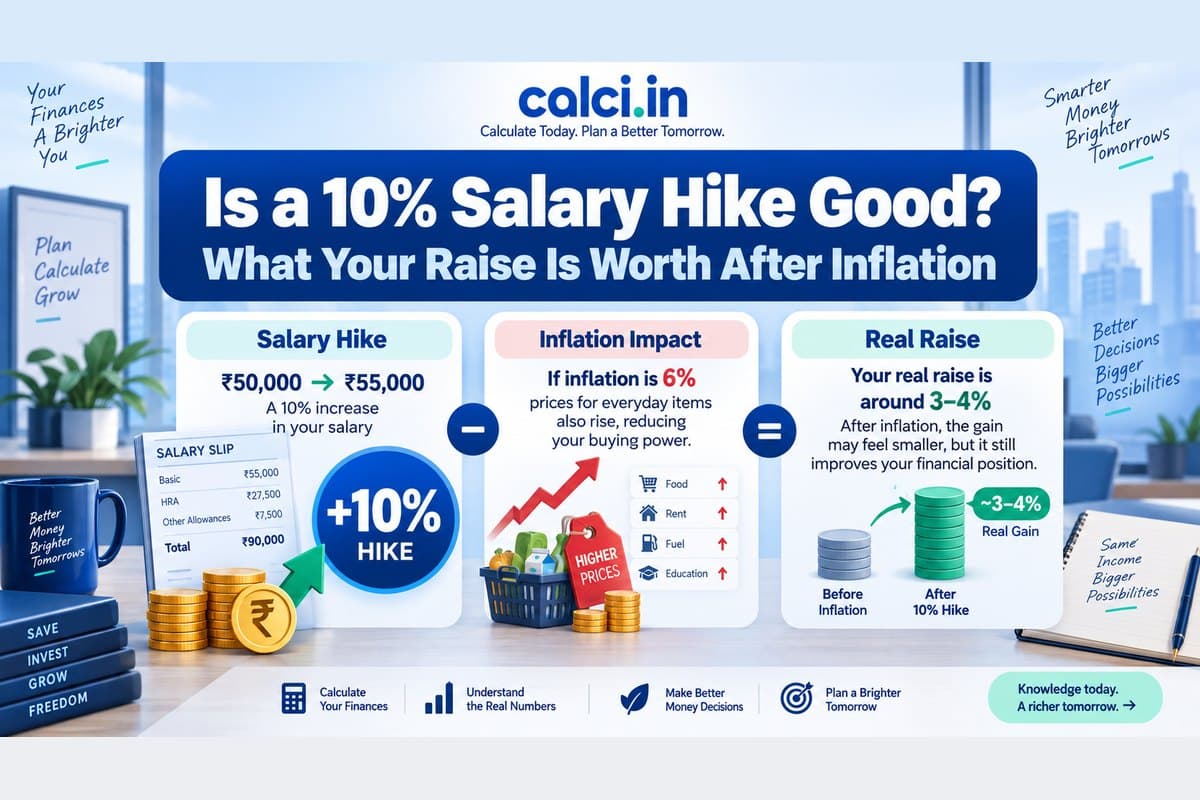
Appraisal letters arrive, and within the hour the same question goes round every office group chat.
"Got 10%. Is that good?"
It might be. It might be a pay cut. The percentage on the letter cannot tell you, because it leaves out the two numbers that decide what a raise is actually worth.
First, take out inflation
A raise is only worth what it buys. If prices rose over the same year, part of your hike was simply keeping up.
The accurate way to strip inflation out is to divide, not subtract:
Real hike = (1 + hike) ÷ (1 + inflation) − 1
A 10% hike with 5% inflation: 1.10 ÷ 1.05 − 1 = 4.76%. Subtracting gives 5%, which is close for small numbers and gets worse as they grow.
| Hike | Inflation 4% | Inflation 5% | Inflation 6% |
|---|---|---|---|
| 5% | 0.96% | 0.00% | −0.94% |
| 8% | 3.85% | 2.86% | 1.89% |
| 10% | 5.77% | 4.76% | 3.77% |
| 12% | 7.69% | 6.67% | 5.66% |
| 15% | 10.58% | 9.52% | 8.49% |
The top row is the one worth staring at. A 5% raise in a 6% inflation year is a pay cut. The salary figure went up, and what it buys went down.
For context, the Reserve Bank of India's inflation target for consumer prices is 4%. Actual inflation in a given year can be above or below that, and the costs that dominate your own budget — rent, school fees, a parent's medicines — can rise much faster than the index.
"Good" compared with what?
There are three honest comparisons, and they can give three different answers.
Against inflation. Anything clearly above it is a real raise. Anything at or below it is standing still or slipping.
Against staying where you are. A modest hike at a job you like, with a manager who will back you for a promotion next year, can beat a bigger number somewhere worse.
Against the market. What people in your role and city are being offered right now. This is the comparison HR does not volunteer, and the one that tells you whether 10% is generous or a quiet discount.
A 10% hike in a 4% inflation year is a real raise of almost 6%. That is decent. Whether it is good depends on the third comparison.
Hikes compound, which is why small differences matter
Each year's hike is applied to a salary that already includes last year's. So the gap between 8% and 12% is not four percentage points; over a decade it is enormous.
Starting from ₹6,00,000:
| Hike every year | Salary after 10 years | In today's money, at 5% inflation |
|---|---|---|
| 6% | ₹10,74,509 | ₹6,59,655 |
| 8% | ₹12,95,355 | ₹7,95,236 |
| 10% | ₹15,56,245 | ₹9,55,400 |
| 12% | ₹18,63,509 | ₹11,44,033 |
Ten years of 6% hikes look like growth: the salary goes from ₹6 lakh to ₹10.7 lakh. Adjusted for 5% inflation, you are about 10% better off than when you started. After a decade.
Ten years of 12% nearly doubles what the salary buys.
That is the case for negotiating hard over a couple of percentage points. It never looks like much in a single year.
Percent is not rupees
A 10% hike on ₹6,00,000 is ₹60,000 a year. That is ₹5,000 a month more, before tax and PF.
The same 10% on ₹12,00,000 is ₹10,000 a month. Same percentage, double the rupees. Which is why a senior colleague's "only 8%" can still be more money than your 12%.
And percentage points are not percent. A hike that falls from 12% last year to 9% this year has dropped by three percentage points — and by 25% in relative terms, since three is a quarter of twelve. Both are correct. They just sound very different in a town hall.
Why take-home pay rarely moves in step
Appraisal letters quote the hike on CTC. Your bank account sees take-home pay, after PF and income tax, and those do not scale evenly.
With basic at half of CTC and the new tax regime:
| CTC | Hike | In hand a month | Rise in take-home |
|---|---|---|---|
| ₹12,00,000 | — | ₹85,396 | — |
| ₹13,20,000 | 10% | ₹93,956 | 10.02% |
| ₹15,00,000 | 25% | ₹1,00,309 | 17.46% |
The 10% hike passes straight through, because taxable income stays inside the rebate that makes income up to ₹12 lakh tax-free.
The 25% hike does not. It lifts taxable income past the rebate limit, tax appears on the whole slab structure, and a quarter more CTC becomes about 17% more take-home.
Neither is bad news. But planning an EMI around "25% more" is a mistake.
A raise, or a new job?
Job changes are usually where the big jumps come from, and it is worth doing the compounding before deciding either way.
From ₹8,00,000:
- stay, with three annual 10% hikes, and you reach ₹10.65 lakh;
- move for a 30% jump, then get 8% hikes, and you reach ₹12.13 lakh in the same three years.
At those rates, staying would not catch up until year eleven. An up-front jump outweighs a slower hike rate for a very long time, which is why the joining number deserves most of the negotiation, not the promised appraisal cycle.
The comparison should still include what the salary figure leaves out: variable pay that may not be paid in full, a gratuity clock that restarts, and whether the new work is work you want to do.
Judging your own hike in five minutes
- Work out the real hike against the inflation you actually felt, not just the headline figure.
- Convert it to rupees a month, after PF and tax.
- Project it for five years at the same rate, to see what the trend is worth.
- Find one market data point for your role before deciding it is fine.
- If you are near ₹12 lakh of taxable income, check what the hike does to take-home before celebrating.
Where these numbers come from
Every real-terms figure in this post depends on one external number: inflation. It is not a matter of opinion and it is published monthly.
The Consumer Price Index, which is the measure a salary should be judged against, comes from the Ministry of Statistics and Programme Implementation. The Reserve Bank of India publishes the same series alongside its own inflation projections, which are the more useful figure when you are negotiating a raise that will be paid over the coming year rather than the one that has passed.
Use the actual rate for the months your raise covers, not the headline number from a news story that may be quoting a different basket or a different month.
The salary hike calculator works out your new salary or the hike percentage, the real rise after inflation and a five-year projection. The in-hand salary calculator shows what a new CTC pays each month. For what prices do to money over longer periods, the inflation calculator is the one to use, and the percentage calculator handles any other percentage change you need to check.