

How to make a time table for study that you actually follow
Most study timetables die by Wednesday because they plan hours you do not have. Here is a method that starts from real free time, with the numbers.
Calci Editorial · · 5 min read
Everyone has made this timetable. Sunday night, fresh sheet of paper, coloured pens. Wake at 5. Physics 5:30 to 7:30. Maths 8 to 11. Chemistry after lunch. Revision till midnight.
By Wednesday it is in a drawer.
The problem is almost never discipline. The timetable planned hours that did not exist: school, coaching, travel, meals and sleep had already taken them. A timetable that works starts the other way round, from the time you actually have.
Step 1: count the hours you really have
Take one ordinary weekday and write down everything that is not study: sleep, school or college, coaching, travel, meals, getting ready, an hour for doing nothing at all. Be honest. Add them up and take the total from 24.
For a typical Class 12 student it looks something like this:
| Activity | Hours |
|---|---|
| Sleep | 8 |
| School, including travel | 7.5 |
| Meals, getting ready, family | 2.5 |
| Free time, phone, play | 1 |
| Left for self-study | 5 |
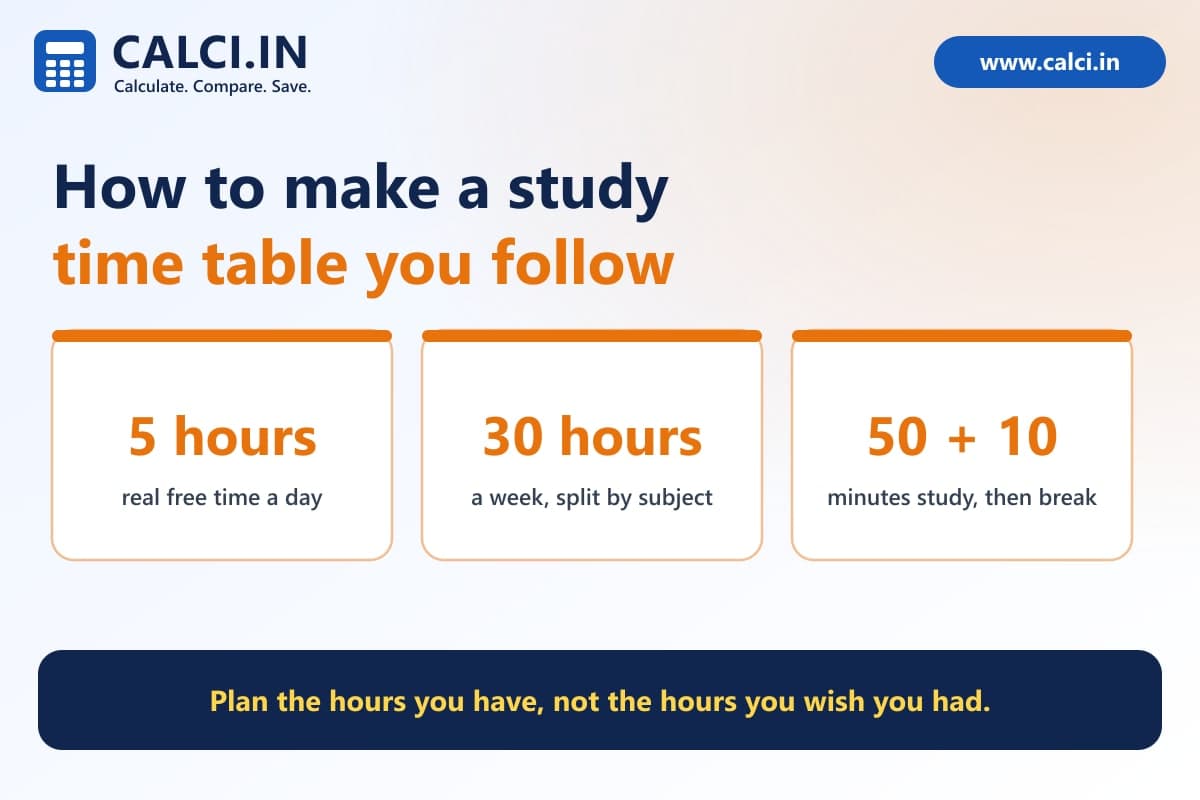
Five hours on a school day. Not eight, not ten. Do the same for Sunday, which usually has more.
Then pick a number you can hit on a bad day, not a good one. If you have five free hours, plan for four or five and treat anything extra as a bonus. A plan you meet every day beats a heroic plan you meet twice.
Step 2: split the week by subject, not by feeling
Say the honest answer is 5 hours a day, 6 days a week: 30 hours. Now decide how those 30 hours are shared. Two things should drive it: how much of the exam a subject carries, and how weak you are in it.
| Subject | Hours a week | Why |
|---|---|---|
| Maths | 9 | Most practice needed, weakest subject |
| Physics | 8 | Heavy numericals |
| Chemistry | 6 | Strong in organic, needs revision in physical |
| English | 3 | Steady, mostly practice papers |
| Revision and tests | 4 | Every week, not just before exams |
| Total | 30 |
The revision row is the one most timetables forget. Without it, a chapter learned in July has faded by December. Four hours a week, every week, is cheaper than four weeks of panic at the end.
Write your own version of this table first. Only then put the subjects into days.
Step 3: work in blocks, not hours
"Study physics from 4 to 7" sounds productive and rarely is. Attention fades long before three hours are up. Break the time into blocks with a short rest between them.
A simple pattern: 50 minutes of study, then a 10-minute break. Each block takes an hour on the clock. Five free hours make five blocks, which is 250 minutes, or 4 hours 10 minutes, of real study. That is less than five hours on paper, and much more than most five-hour sessions actually deliver.
If 50 minutes feels long, start with 25 minutes on and 5 off, the pattern the Pomodoro Technique made popular. Our study timer runs that cycle for you, with a longer break after every four sessions, and counts how many you finished today.
A few rules make the blocks stick:
- One subject per block. Do not mix three chapters in an hour.
- Hard subjects early, when you are fresh. Put lighter work, such as English reading or formula revision, in the evening.
- Two blocks of the same subject back to back at most. After that, switch.
- The break is a real break. Stand up, drink water, look out of the window. Ten minutes of scrolling is not a rest for the eyes or the brain.
Step 4: put it on a grid
Now draw the week: days across the top, times down the side, one block per cell. Fill in the subjects from your Step 2 table until each subject has its hours. Sunday gets the longer revision session and a mock test.
Keep one evening block a week empty. Something will always come up, a function at home, a test in school, a bad day. An empty block absorbs it without wrecking the rest of the week.
You can draw this on paper, in Excel or Word, or let a tool lay it out. Our timetable maker builds the grid from the days, the start time, the block length and the breaks, lets you type subjects in and colour them, and prints a clean page or saves it as a PDF. It works for school and class timetables too, with periods and lunch breaks.
Step 5: stick it up, and review it on Sunday
A timetable inside a notebook gets forgotten. Print it and stick it where you study, or set it as your phone wallpaper.
Then, every Sunday, spend ten minutes looking back at the week:
- Which blocks did you actually complete? Tick them off as you go, so this takes seconds.
- Which subject keeps getting skipped? That is usually the one you fear, and it needs an earlier, fresher slot, not fewer hours.
- Was the plan too heavy? If you finished only 20 of 30 blocks, plan 25 next week, not 30 again.
The timetable is a tool, not a promise. Changing it after a week of evidence is the point.
Why most timetables fail
Looking back at the Sunday-night version, every mistake is visible:
- It started from the hours wanted, not the hours available. Step 1 fixes that.
- It had no breaks. Three-hour sessions are not three hours of learning.
- It had no slack. One missed session pushed everything back, and the whole plan collapsed.
- It had no revision. Material learned once and never revisited does not survive to the exam.
- It was never reviewed. The same impossible plan was written again the next Sunday.
A note on sleep
Cutting sleep to find study hours is the trade that looks clever and is not. A tired student reads the same page three times. Keep the sleep row in Step 1 at a level that lets you wake without an alarm on most days, and take the study hours from somewhere else: the phone row is usually the honest place to look.
Exams reward the work you do consistently for months, not the hours you plan on Sunday. A modest timetable that you follow for twelve weeks will carry you further than a perfect one that lasts three days. Build it from your real hours, give each block one job, and review it once a week.