

Step-up SIP vs flat SIP: the 10% raise that nearly doubles your corpus
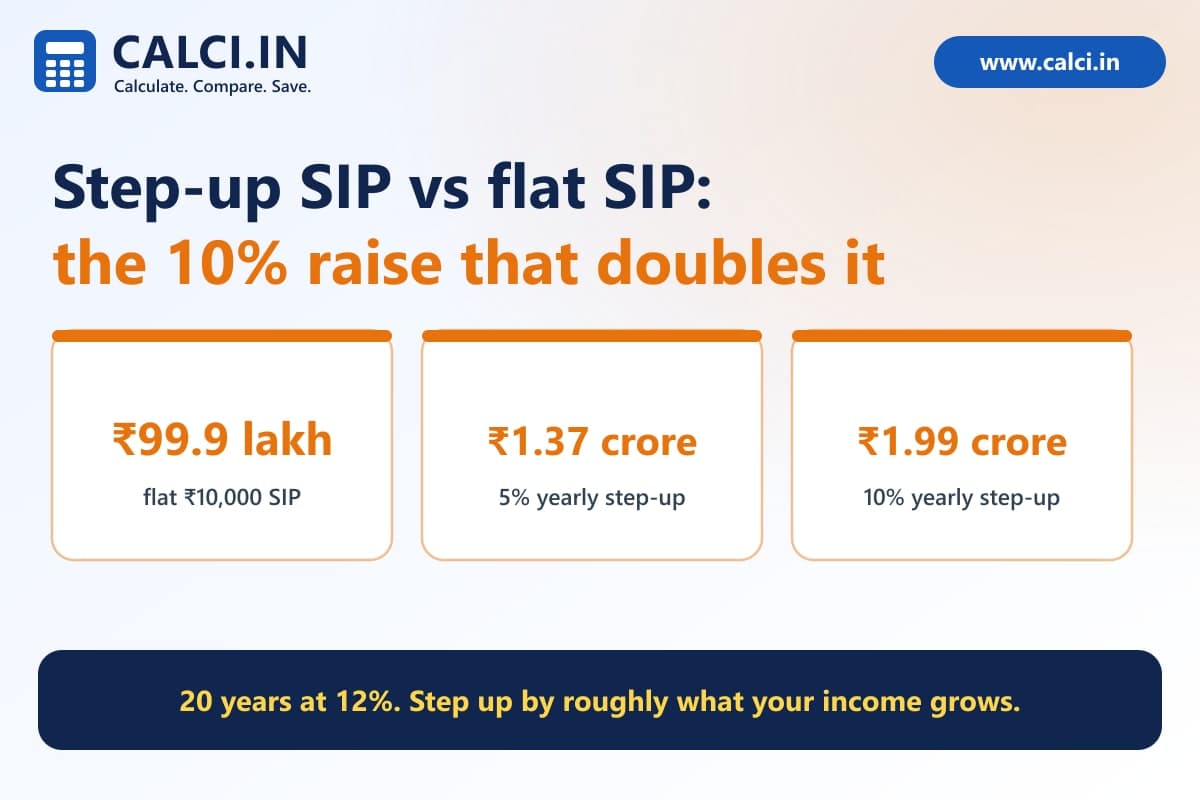
A flat ₹10,000 SIP reaches ₹99.9 lakh in 20 years at 12%. Raise it 10% a year and it reaches ₹1.99 crore. Here is what that really takes.
Calci Editorial · · 5 min read
Two people start a ₹10,000 SIP on the same day, in the same fund, and stay for 20 years. One keeps paying ₹10,000 every month. The other increases the amount by 10% each April.
At 12% a year, the first has ₹99.9 lakh at the end. The second has ₹1.99 crore.
Same fund. Same starting amount. Double the result. It is the most useful single idea in monthly investing, and also the one most often oversold, so this post puts numbers on both halves.
The raw comparison
All three assume ₹10,000 a month to begin with, 12% a year, 20 years, instalments at the start of each month:
| Plan | You put in | You end with | Gains |
|---|---|---|---|
| Flat ₹10,000 | ₹24,00,000 | ₹99,91,479 | ₹75,91,479 |
| Step-up 5% a year | ₹39,67,914 | ₹1,37,37,623 | ₹97,69,709 |
| Step-up 10% a year | ₹68,73,000 | ₹1,98,88,715 | ₹1,30,15,716 |
The numbers come straight from the SIP calculator, which has a step-up field.
Notice what is doing the work. The 10% plan ends with 99% more money, but you also put in 186% more of your own: ₹68.7 lakh against ₹24 lakh. So the step-up is not a trick for free money. It is a way of saving more as you earn more, with the added benefit that the extra rupees go in earlier than if you had saved them up and invested later.
How big does the instalment get?
This is the question that decides whether a step-up plan is realistic, so it deserves a straight answer. A 10% raise on ₹10,000 sounds modest. Twenty years of it is not.
- Year 1: ₹10,000 a month
- Year 5: ₹14,641
- Year 10: ₹23,579
- Year 15: ₹37,975
- Year 20: ₹61,159
By the last year you are putting away about ₹61,000 a month. If your salary grows by 10% a year, that is exactly proportionate: the SIP stays the same share of your income throughout. If your salary grows by 5%, the SIP slowly eats a bigger share of what you earn, and it will become uncomfortable around year 10.
The 5% plan is gentler: ₹25,270 a month in year 20, and it still ends at ₹1.37 crore.
So the honest framing is not "step up by 10% for 20 years and double your money". It is: step up by roughly what your income grows, and the plan stays affordable while compounding is given more to work on.
Starting smaller is the better use of it
Here is the case I like best. Suppose ₹10,000 is stretching you right now, but you expect your income to rise. Compare a flat ₹10,000 SIP with one that starts at ₹5,000 and steps up 10% a year:
| Plan | You put in | You end with |
|---|---|---|
| Flat ₹10,000 | ₹24,00,000 | ₹99,91,479 |
| ₹5,000 start, +10% a year | ₹34,36,500 | ₹99,44,358 |
Practically the same corpus, under ₹50,000 apart on ₹1 crore. But the second plan asks for half as much in the first year, and the first year is when money is tightest. You pay for that with ₹10.4 lakh more invested over 20 years, spread across years in which you can presumably afford it.
If you start at ₹7,000 and step up 10% a year, you end with ₹1.39 crore. If you start at ₹5,000 and step up 15%, you end with ₹1.51 crore, though by year 20 the monthly amount is about ₹71,000, and that stretches belief for most careers.
The version of the plan that is actually the same
You can reach the ₹1.99 crore of the 10% step-up plan without any step-up at all. A flat SIP of ₹19,906 a month, started on day one, ends in the same place, with ₹47.8 lakh invested.
Two ways to the same corpus, then:
- ₹19,906 a month from the start, flat.
- ₹10,000 a month rising 10% a year, with ₹68.7 lakh going in over time.
The first puts in about ₹21 lakh less. It also asks for twice as much on day one. If you can afford ₹19,906 now, the flat plan is cheaper. The step-up plan exists for the many people who cannot, and whose future selves can.
Where step-up plans go wrong
The step-up is a promise to yourself, and funds do not enforce it. Many platforms offer a built-in annual increase, but the default is often zero. Set it up at the start, or the intention fades by the second April.
A bad year breaks the pattern. A job loss, a medical bill or a house deposit can pause the plan, and a pause hurts a step-up plan more than a flat one because the later, larger instalments are the ones that do most of the work.
Raising too fast buries you. At 15% a year, a ₹5,000 SIP is about ₹71,000 a month by the end. Few incomes keep pace with that, and what does not fit gets cut.
The return is not guaranteed. Everything above assumes a steady 12%, and equity does not behave that way. A step-up plan invests more in later years, so a weak market near the end hurts it more than it would hurt a flat plan, and a strong market near the end helps it more. That is a reason to match the plan to your time horizon, not a reason to avoid it.
How to set one up
- Decide what you can start with, not what you wish you could. A SIP that survives beats a larger one that stops.
- Pick a step-up close to your usual pay rise. If you are unsure, 5% is hard to regret.
- Put the increase date where you will notice it, such as the month your appraisal lands.
- Revisit once a year. If income has outrun the step-up, raise the SIP by more.
You can run your own version in the SIP calculator by setting the step-up field, and the post on reaching ₹1 crore shows what a flat plan needs for different years and returns. For a lump sum alongside a SIP, the lumpsum calculator does the other half.
The short version
A 10% yearly step-up turns a flat ₹10,000 SIP from ₹99.9 lakh into ₹1.99 crore over 20 years at 12%, but only by asking for ₹68.7 lakh of your money instead of ₹24 lakh, and a final instalment of about ₹61,000. Use a step-up that tracks your income. Start smaller if you must, and start now.