

How much SIP do you need for ₹1 crore? The table by rate and years
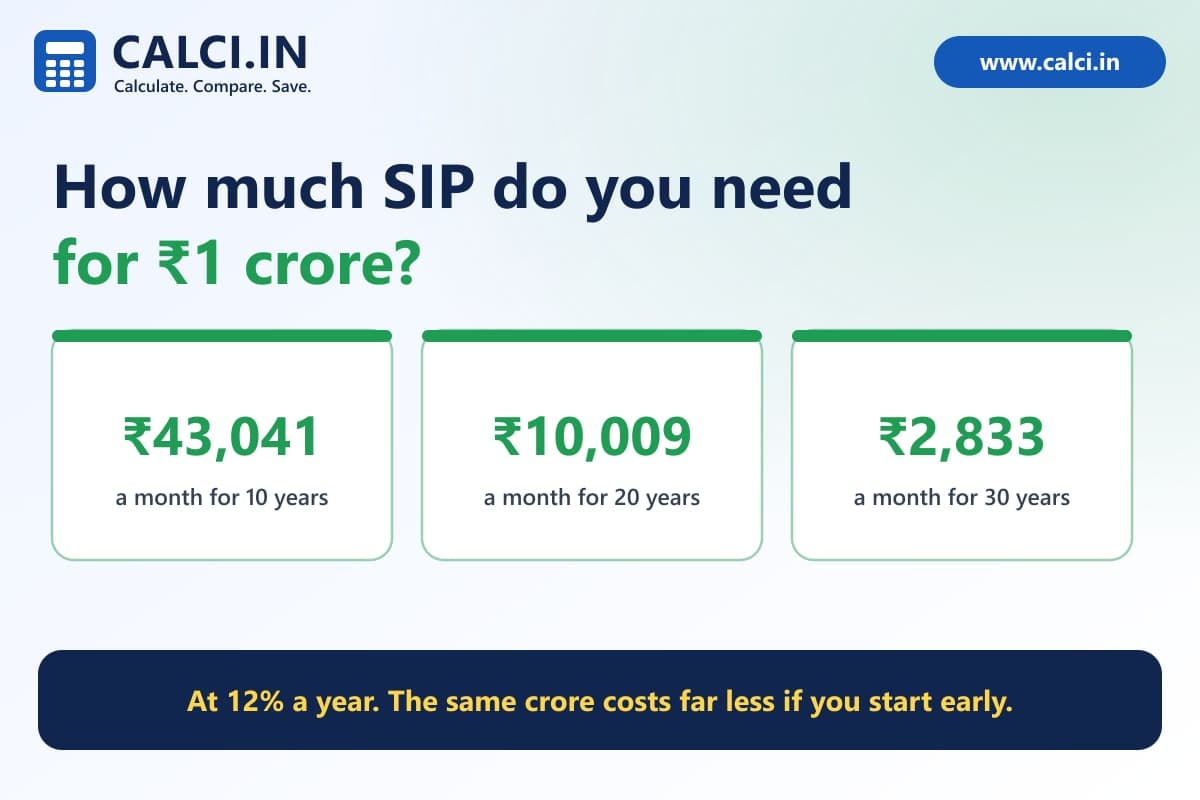
₹10,009 a month for 20 years at 12%, or ₹43,041 for 10 years. The same crore costs wildly different amounts depending on when you start.
Calci Editorial · · 5 min read
Ask ten people what they need to save for ₹1 crore and you will get ten answers, mostly ending in "it depends". They are right, and it depends on exactly two things you control and one you do not.
The two you control: how many years you give it, and how much you put in each month. The one you do not: the return, which nobody knows in advance and which this post treats as a scenario rather than a promise.
Here is what ₹1 crore costs when you work it backwards.
The table
Monthly SIP needed to reach ₹1,00,00,000, with the instalment invested at the start of each month and the annual return divided into twelve equal monthly rates, which is how the SIP calculator works it out:
| Years | at 8% | at 10% | at 12% | at 15% |
|---|---|---|---|---|
| 10 | ₹54,299 | ₹48,414 | ₹43,041 | ₹35,886 |
| 15 | ₹28,707 | ₹23,928 | ₹19,819 | ₹14,774 |
| 20 | ₹16,865 | ₹13,060 | ₹10,009 | ₹6,597 |
| 25 | ₹10,445 | ₹7,474 | ₹5,270 | ₹3,045 |
| 30 | ₹6,665 | ₹4,387 | ₹2,833 | ₹1,427 |
Read across a row and you see what the return does. Read down a column and you see what time does. Time wins by a distance.
Take the 12% column. Thirty years needs ₹2,833 a month. Twenty years needs ₹10,009, about three and a half times as much. Ten years needs ₹43,041, more than fifteen times the thirty-year figure. The target did not change. Only the number of years did.
What you actually put in
The more telling table is the one that shows how much of your own money goes in. At 12% the total you invest for ₹1 crore is:
- 10 years: ₹51,64,865
- 15 years: ₹35,67,352
- 20 years: ₹24,02,047
- 25 years: ₹15,80,915
- 30 years: ₹10,19,855
At ten years, more than half of the crore is your own money and the market has contributed the rest. At thirty years, the market has contributed nearly ninety paise of every rupee, and you have put in ₹10 lakh. That is what people mean by compounding, and it only shows up if you stay long enough for the last years to do the heavy lifting. In a 20-year plan at 12%, roughly a third of the final corpus is built in the last three years, which is also when a market fall hurts most.
The cost of waiting
Suppose you plan to reach ₹1 crore at 12% and you are choosing between starting now with 20 years to go, or starting five years later with 15.
Starting now: ₹10,009 a month. Starting in five years: ₹19,819 a month.
Almost double. Five years of delay does not cost five years of savings; it costs half again on top of what you would have saved, because those five years were the ones in which your money would have had the longest to grow. If you are 30 and wondering whether to start at ₹5,000 now or wait until a raise lets you start at ₹10,000, the arithmetic says to start now with ₹5,000 and raise it later. A step-up SIP, covered in the next post on this, is how.
What the table does not tell you
Four things, and each one matters more than the third decimal place of any return.
The return is not guaranteed. 12% is a common planning assumption for equity funds over long periods, not a figure anyone can promise. A fund can return 18% in one year and minus 20% in the next, and a 20-year average hides a wide range of experiences. If you cannot stomach the second kind of year, the 8% column is a better planning number than the 15% one, and a plan that needs 15% to work is a plan that depends on luck.
Taxes come out of the gains. The figures above are before tax. Gains on equity funds are taxed when you sell, and the rate has changed several times in recent years, so check the current rule when you get close. Plan on keeping somewhat less than the table says.
₹1 crore will not be worth ₹1 crore. In 20 years at 6% inflation, today's ₹1 crore is worth ₹31.18 lakh in today's money, which means you would need ₹3.2 crore then to buy what ₹1 crore buys now. If the goal is to maintain a lifestyle rather than hit a round number, set the target in future rupees. The post on what ₹1 crore buys in 20 years works it through.
The model is tidy and life is not. The calculator assumes an instalment on the first day of every month and a constant monthly rate. Real SIPs miss months, funds charge expenses that are already inside the return you see, and the market does not compound at 1% a month on schedule.
How to use it
Pick the number of years first, because it is the one you can least afford to be wrong about. Then look at the row for that number of years and ask which column you can live with. If the answer is the 10% column, that is your monthly figure, and it is more useful than a number that needs a perfect market.
A few rules of thumb the table supports:
- To reach ₹1 crore in 20 years at 10%, you need about ₹13,000 a month. That is roughly what many salaried people in their early thirties can already set aside, if they begin before lifestyle expands to fill the income.
- Doubling the SIP does not halve the time. It takes about 20 years at 12% with ₹10,009 and still about 15 years with ₹19,819, a saving of five years for double the money. The first rupees are the most valuable.
- If your target is smaller or larger, the figures scale in proportion. ₹50 lakh needs half of every number in the table, and ₹2 crore needs twice.
To try your own numbers, enter the target, the years and the return in the SIP calculator, or, if you have a lump sum to invest alongside the SIP, compare it with the lumpsum calculator. For a goal with a date, such as a child's education, the savings goal calculator solves for the monthly amount directly.
The short version
For ₹1 crore at 12%: ₹43,041 a month for 10 years, ₹19,819 for 15, ₹10,009 for 20, ₹5,270 for 25 and ₹2,833 for 30. Waiting five years from a 20-year plan nearly doubles the monthly amount. And treat the return as a scenario: a plan that works at 10% is sturdier than one that needs 15%.
None of this is investment advice, and the right amount depends on your income, your other goals and how much risk you can carry. It is arithmetic, which is the part that does not change with your opinion.