

Markup vs margin: why a 50% markup is not a 50% profit
A shopkeeper who adds 50% to cost has a 33.3% margin, not 50%. The gap widens with every extra point, and it is how many businesses quietly underprice.
Calci Editorial · · 5 min read
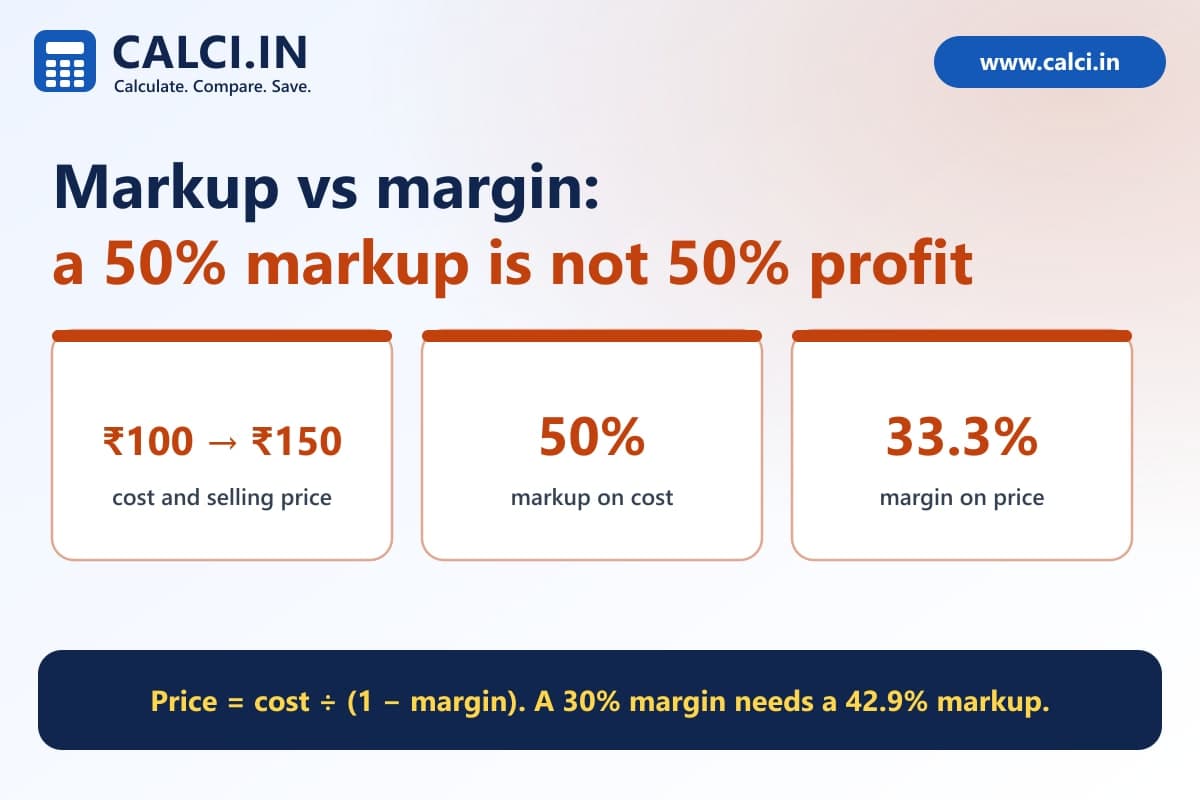
A friend of mine sells school uniforms. She buys a shirt for ₹800, adds 50% and sells it for ₹1,200. For two years she told people her margin was 50%. It was 33.3%.
She was never short of customers or honest about the numbers. She was using one word for two different things, and the difference was costing her real money every time she set a price from a target.
This is probably the most common arithmetic slip in small business, and it is easy to fix once you can see it.
Two ratios, one profit
Both measures start from the same rupee profit: selling price minus cost. They differ only in what you divide it by.
- Markup is profit divided by cost. It answers: "by what percentage did I mark up what I paid?"
- Margin is profit divided by selling price. It answers: "what share of what the customer pays do I keep?"
For the shirt: cost ₹800, price ₹1,200, profit ₹400.
- Markup: 400 ÷ 800 = 50%
- Margin: 400 ÷ 1,200 = 33.3%
Same ₹400. Margin is always the smaller figure, because the price is always bigger than the cost, and the more you add, the bigger the gap.
The table to keep on the wall
Markup on cost against the margin it produces, from the markup and margin calculator:
| Markup | Margin |
|---|---|
| 10% | 9.09% |
| 20% | 16.67% |
| 25% | 20.00% |
| 30% | 23.08% |
| 40% | 28.57% |
| 50% | 33.33% |
| 75% | 42.86% |
| 100% | 50.00% |
| 150% | 60.00% |
At low markups the two are close, which is why the confusion survives for years. At 10% they are within a point of each other. By 50% they are 17 points apart. A margin can never reach 100%, since that would mean the product cost nothing, but a markup can be 200% or more without anyone noticing.
The formulas, if you want to keep them in your head:
- Margin = markup ÷ (1 + markup)
- Markup = margin ÷ (1 − margin)
Try them with decimals. A markup of 0.5 gives 0.5 ÷ 1.5 = 0.333. A margin of 0.3 gives 0.3 ÷ 0.7 = 0.4286.
Where it hurts: pricing from a target
Say you decide you want a 30% margin. Most people take 30%, add it to the cost, and get the wrong price.
On a ₹1,000 cost:
- Adding 30% gives ₹1,300, which is a margin of 300 ÷ 1,300 = 23.1%. You are short by almost seven points.
- Getting a real 30% margin needs a 42.86% markup, which is a price of ₹1,429. The profit is ₹429, and 429 ÷ 1,429 is 30%.
The gap is not small. On every ₹1,000 of stock you sell at the wrong price, you give up about ₹129 of profit. On ₹10 lakh of annual cost, that is ₹1.29 lakh a year, and it comes straight off the bottom line.
The correct way to price from a target margin is to divide: price = cost ÷ (1 − margin). For a ₹800 shirt:
| Target margin | Price | Markup it needs |
|---|---|---|
| 20% | ₹1,000 | 25.0% |
| 25% | ₹1,067 | 33.3% |
| 30% | ₹1,143 | 42.9% |
| 40% | ₹1,333 | 66.7% |
| 50% | ₹1,600 | 100.0% |
A business that wants a 50% margin has to charge double what it paid. Which sounds obvious when you say it that way, and nowhere near obvious when someone says "I want to make 50%".
Discounts and the thin edge
Margin is also the number that tells you how much room a discount leaves. With the shirt at ₹1,200, a 10% discount is a price of ₹1,080 and a profit of ₹280. The margin falls from 33.3% to 25.9%. A 20% discount takes the profit to ₹160 and the margin to 16.7%.
The discount that wipes out all the profit is not 50% off, as the markup suggests. It is 33.3%, the margin. A shopkeeper who thinks 50% markup is a 50% profit may believe he can afford a half-price sale. He cannot; at a third off, he has sold at cost, and at half off he loses ₹200 on every shirt.
The discount calculator shows the price and savings of any offer, and the profit margin calculator works out gross, operating and net margin from a full statement.
Which one should you use?
Both. They answer different questions.
Use markup when you are setting a price from a cost. It is natural to say "I add 40% to what I pay", and a shop with a standard markup per product category can apply it quickly.
Use margin when you are judging the business. Margin is the share of revenue you keep, and it is what lets you compare yourself with another business, a past year or a supplier's quotation. It is the number that sits next to rent and wages when you work out what is left over.
Many accounting statements and most comparisons between businesses use margin, while shopkeepers and wholesale price lists often use markup, so you will meet both. The skill is knowing which one you have been given. Ask: "of what?" If the answer is "of the cost", it is a markup, and if it is "of the selling price" it is a margin.
A checklist before you set a price
- Write down the cost, including freight and anything you pay to bring the item in.
- Decide the margin you need, not the markup, and be honest about it. It has to cover rent, wages, power, losses and your own pay.
- Divide: price = cost ÷ (1 − margin).
- Check what a 10% discount does to the margin, and decide whether you can live with that.
- If the price looks too high for the market, the answer is lower costs or a smaller margin, not a quietly wrong sum.
The markup and margin calculator does the conversion both ways. Put in the two prices to see both figures, or set a target margin to find the price that produces it.
The short version
Markup is profit over cost, margin is profit over price, and margin is always smaller. A 50% markup is a 33.3% margin, 100% is 50%, and to earn a true 30% margin you need a 42.9% markup. Price from the margin you want by dividing cost by one minus the margin, and your shirts stop being sold for less than you think.