

What ₹1 crore will buy in 20 years: inflation in plain numbers
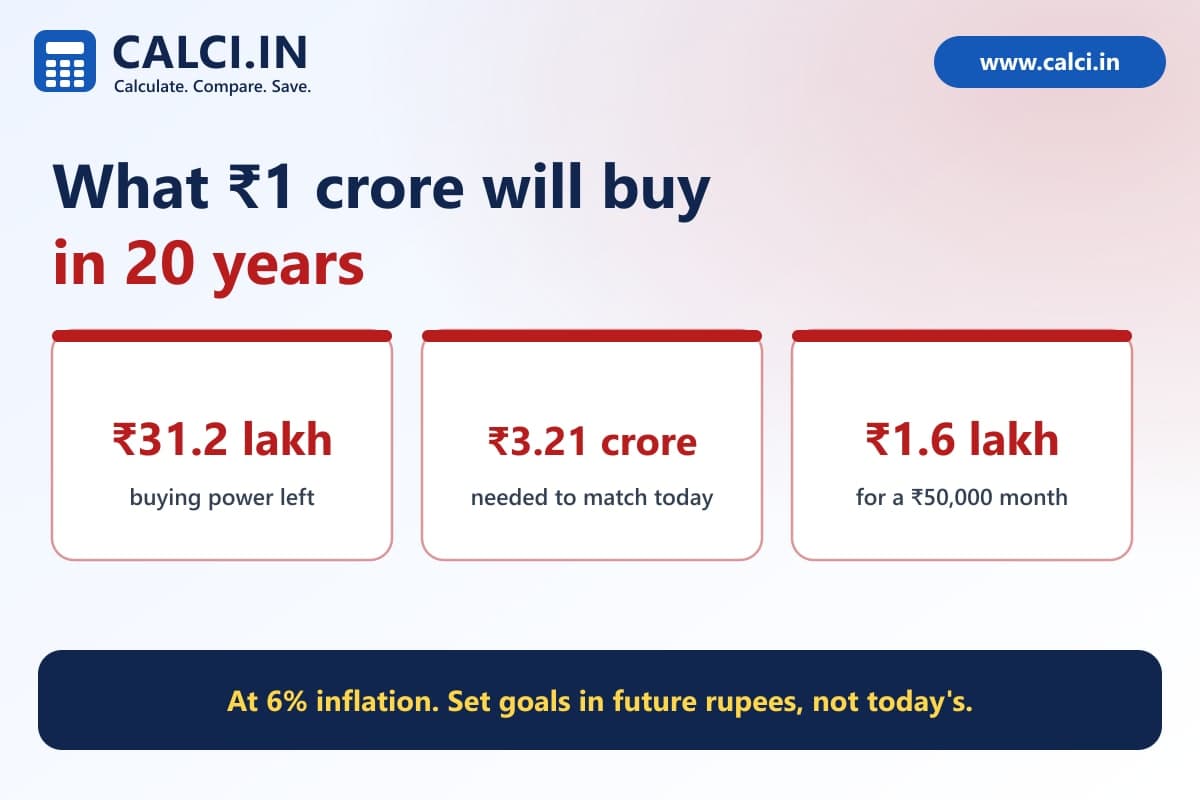
At 6% inflation, ₹1 crore in 2046 buys what ₹31.2 lakh buys today. To keep today's buying power you would need ₹3.2 crore. Here is how to plan for it.
Calci Editorial · · 6 min read
Ask anyone whether ₹1 crore is a lot of money and they will say yes. Ask whether it will still be a lot in 20 years and the answer gets vaguer. Everyone knows prices rise. Very few people have done the sum that shows how much.
This post does the sum, with figures you can check yourself, and then looks at what it should change about how you save.
The core idea: a rupee is not a fixed amount of stuff
Inflation is the rate at which prices rise. If it runs at 6% a year, something that costs ₹100 today costs ₹106 next year, ₹112.36 the year after, and so on. Prices compound exactly like an investment does, only in the wrong direction for you.
Two ways of saying the same thing:
- Future cost: what an item costing ₹X today will cost later = X × (1 + inflation) ^ years
- Buying power: what ₹X kept as cash will buy later, in today's money = X ÷ (1 + inflation) ^ years
At 6% for 20 years the multiplier is 3.2071. The inflation calculator confirms it: ₹1,00,000 of spending today becomes ₹3,20,714 in 20 years, and ₹1,00,000 held as cash will buy only ₹31,180 of today's goods. That is a loss of 69% of its buying power, with the money sitting there untouched.
₹1 crore over time at 6%
Take ₹1 crore and ask what it is worth in today's rupees after some years:
| After | Buying power in today's money |
|---|---|
| 5 years | ₹74.7 lakh |
| 10 years | ₹55.8 lakh |
| 15 years | ₹41.7 lakh |
| 20 years | ₹31.2 lakh |
| 30 years | ₹17.4 lakh |
The money loses about a quarter of its buying power in five years, and half in under twelve. At 6%, prices double roughly every 11.9 years, which is the figure to remember: divide 72 by the inflation rate for a quick estimate (72 ÷ 6 = 12).
It matters what the inflation rate turns out to be
Nobody knows the rate for the next 20 years. India's long-run average has been in the region of 5 to 7%, but it has moved around, and your own household's inflation can differ from the national figure. School fees, medical care and property have often risen faster than the headline number. So here is the same ₹1 crore at different rates, after 20 years:
| Inflation | ₹1 crore buys what this buys today | You need this to match today's ₹1 crore |
|---|---|---|
| 4% | ₹45.6 lakh | ₹2.19 crore |
| 5% | ₹37.7 lakh | ₹2.65 crore |
| 6% | ₹31.2 lakh | ₹3.21 crore |
| 7% | ₹25.8 lakh | ₹3.87 crore |
| 8% | ₹21.5 lakh | ₹4.66 crore |
Two points stand out. First, the gap between 4% and 8% is huge: the same ₹1 crore is worth ₹45.6 lakh in one world and ₹21.5 lakh in the other. Second, no plausible rate leaves ₹1 crore in 2046 looking like ₹1 crore today. If your goal is written as a round number, check it against this table.
What your monthly expenses become
The effect is easier to feel with a monthly budget. Suppose a household spends ₹50,000 a month today. At 6% inflation, the same lifestyle costs:
| In | Monthly cost of the same life |
|---|---|
| 5 years | ₹66,911 |
| 10 years | ₹89,542 |
| 15 years | ₹1,19,828 |
| 20 years | ₹1,60,357 |
| 30 years | ₹2,87,175 |
A family that retires in 20 years on "₹50,000 a month, which is what we spend now" will find that the true figure is ₹1.6 lakh a month. A ₹1 crore corpus generating, say, 7% a year gives about ₹58,000 a month in interest, before tax. That is a bit more than a third of what the life now costs.
This is the reason retirement plans built on today's expenses fall short. It is not a failure of investing. It is a failure to price the target in future rupees.
Does a fixed deposit keep up?
A fixed deposit feels safe, and in terms of capital it is. In terms of buying power, it is closer to break-even than people think.
Take ₹1,00,000 in a 5-year FD at 7%, compounded quarterly. The FD calculator gives a maturity of ₹1,41,478, and for someone in the 30% tax slab, interest is taxed every year, so the effective growth after tax is 5.23% a year.
Against 6% inflation that is a real return of (1.0523 ÷ 1.06) − 1 = −0.7% a year. The balance grows in rupees and shrinks in what it buys. Across 20 years the loss is small each year, but it is a loss.
It is not that FDs are bad. They are the right place for money you will need within a few years and cannot risk, or for an emergency fund. They are a poor place for money that must grow for 20 years. The same comparison for PPF, FD and equity is worked out in PPF vs FD vs SIP.
How to plan around it
1. Set targets in future rupees. Work out today's cost, multiply by (1 + inflation) ^ years, and use that as the goal. For ₹1 crore of today's buying power in 20 years at 6%, the target is ₹3.21 crore.
2. Look at the real return, not the headline. Subtract inflation from the return after tax. An investment that returns 12% when inflation is 6% grows your buying power by about 5.7% a year, not 12%.
3. Make the SIP big enough. To reach ₹3.21 crore in 20 years at an assumed 12% return, a flat monthly SIP of about ₹32,100 is needed, as the SIP calculator shows. If that sounds like too much, a step-up SIP lets you start lower and rise with your income.
4. Raise savings with your salary. A pay rise that only matches inflation leaves you where you were. See what a hike really gives you in the salary hike calculator, which compares it with inflation.
5. Keep part of the money in assets that can outgrow prices. Over long periods, equity and some real assets have beaten inflation, and short-term bank deposits have mostly matched it at best. No asset does so every year, which is why the mix depends on how long you can wait.
6. Revisit the numbers every year. If inflation runs hotter than planned, the target moves. Updating once a year is much cheaper than finding out at 58.
What this does not mean
Do not read this as a reason to panic or to chase risky returns. Inflation is slow, and it is the same for everyone who holds cash. The honest conclusions are modest:
- ₹1 crore is worth much less in 20 years, but not nothing: it is still ₹31 lakh of today's goods.
- The error is not saving too little in rupees. It is measuring the goal in the wrong rupees.
- The longer the horizon, the more the inflation assumption matters, and the more sensible it is to test two or three rates rather than one.
The post on reaching ₹1 crore with a SIP shows the monthly amount for each rate and period. Combine it with the table above and you can set a target that means what you think it means.
The short version
At 6% inflation, ₹1 crore kept for 20 years buys what ₹31.2 lakh buys today, and you would need ₹3.21 crore to match today's ₹1 crore. A ₹50,000 monthly budget becomes ₹1.6 lakh. A 30%-slab FD at 7% earns about 5.2% after tax, which is slightly below inflation. Price your goals in future rupees, check the real return and save accordingly.