

PPF vs FD vs SIP: where should your money actually go?
Same ₹12,500 a month for fifteen years. One ends at ₹39.7 lakh, one at ₹40.7 lakh, one at ₹63.1 lakh. The gaps are not where most people expect.
Calci Editorial · · 5 min read
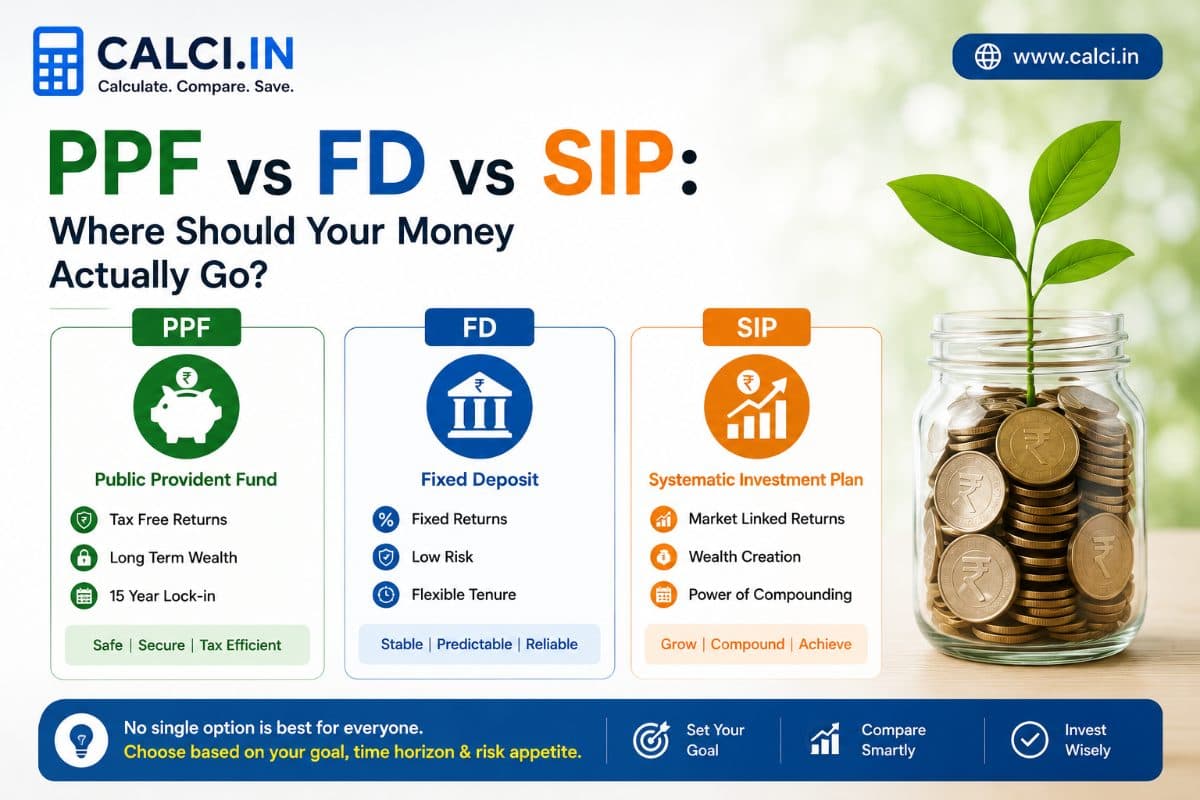
Three products. Same money, same period, and a comparison that is usually done badly because people compare the wrong number.
₹12,500 a month — ₹1.5 lakh a year, which is the PPF ceiling — for fifteen years.
| Total put in | Ends at | Tax on gains | |
|---|---|---|---|
| Recurring deposit at 7% | ₹22,50,000 | ₹39,71,028 | Slab rate |
| PPF at 7.1% | ₹22,50,000 | ₹40,68,209 | None |
| SIP at 12% | ₹22,50,000 | ₹63,07,200 | LTCG above exemption |
The SIP is ₹22 lakh ahead. The PPF is barely ahead of the deposit on the headline figure and considerably ahead after tax.
Neither of those is the interesting part.
Start with the tax, because it decides more than the rate
A 7% fixed deposit and a 7.1% PPF look like the same product with a rounding difference.
Tip: The PPF calculator and the FD calculator both show the maturity figure after tax, which is the only number worth comparing.
They are not remotely the same product.
FD and RD interest is taxed at your full slab rate, every year, as it accrues. Not when it matures — as it accrues. In the 30% bracket a 7% deposit returns 4.9%.
PPF is exempt-exempt-exempt. The deposit is deductible under 80C, the interest is untaxed, the maturity is untaxed. 7.1% stays 7.1%.
To match a tax-free 7.1% you would need a taxable deposit paying 10.14% in the 30% bracket. No bank offers that. That gap — not the 0.1% on the headline — is the entire product.
| Instrument | Headline | After 30% tax | Against 5% inflation |
|---|---|---|---|
| Savings account | 3.0% | 2.10% | −2.90% |
| Fixed deposit | 7.0% | 4.90% | −0.10% |
| PPF | 7.1% | 7.10% | +2.10% |
| Equity, long run | 12.0% | 10.80% | +5.80% |
Sit with the fixed deposit row. Entirely safe, fully guaranteed, and in the top tax bracket it preserves purchasing power and nothing more.
That is not an argument against fixed deposits. For money you need in two years it is exactly right. It is a complete argument against holding a thirty-year horizon in one.
What each is actually for
Stop asking which is best. They are not competing for the same money.
Fixed and recurring deposits are for money with a date attached. School fees in eighteen months. A down payment in three years. An emergency fund that must be intact whatever the market does. The guaranteed nominal amount is the entire point, and 4.9% post-tax is an acceptable price for certainty.
PPF is for the fixed-income part of a long-term portfolio. Fifteen-year lock-in, government-backed, and the only tax-free rate in India worth having. If you were going to hold some debt for twenty years anyway, this is where it should sit — at which point the lock-in stops being a cost, because that money was never going to be touched.
SIP into equity is for money with a horizon over seven years and no fixed date. It is the only one of the three that can outrun inflation meaningfully, and the only one that can be down 30% on the day you need it.
The right answer for most people is all three, in different proportions, for different money.
The PPF rule that costs people money
Interest is calculated on the lowest balance between the 5th and the last day of each month.
A deposit arriving on the 6th earns nothing that month.
On ₹1,50,000 deposited annually, depositing on 6 April instead of 5 April costs about ₹888 in year one. Repeated for fifteen years, compounding, the total runs past ₹20,000.
For one day.
Deposit on or before the 5th of April, every year. That is the whole optimisation and it is worth more than most fund selection decisions of the same size.
What extending PPF does
Most people withdraw at fifteen years. That is usually wrong, and the arithmetic is striking.
| Total years | Balance at 7.1% |
|---|---|
| 15 | ₹40,68,209 |
| 20 | ₹66,58,288 |
| 25 | ₹1,03,08,015 |
The five years from twenty to twenty-five add ₹36.5 lakh on ₹7.5 lakh of fresh deposits. That block earns more interest than the entire first fifteen years produced.
An account opened at 25 and extended twice reaches a crore of tax-free money by 50, on ₹12,500 a month.
The extension form has to be submitted within one year of maturity. Miss it and the account keeps earning interest but accepts no further contributions — which quietly removes the most valuable option available.
Where the SIP figure is soft
The ₹63.07 lakh above assumes 12%, constant, for fifteen years. That is an assumption I chose, and it is doing a lot of work.
Indian equity funds have averaged roughly 11–13% over long periods. That average contains years of +40% and years of −30%, and the order those arrive in changes the outcome even when the average does not.
Run it at 8% and the same SIP gives about ₹43 lakh — still ahead of PPF, and by far less than the headline comparison suggests.
Also: the ₹63 lakh is before tax, expense ratio and exit load. An expense ratio of 1.5% against 0.5% over fifteen years costs a meaningful share of it, and equity gains held over a year attract LTCG above the annual exemption.
The PPF figure has none of those caveats. Its number is its number.
That certainty is worth something real, and comparisons that ignore it are comparing an estimate with a guarantee and calling the estimate the winner.
An allocation I would defend
For someone in their thirties with a fifteen-plus year horizon and no unusual circumstances:
Emergency fund first — six months of expenses in a sweep-in FD or a liquid fund. Not invested. This is not the exciting part and skipping it is what turns every unplanned expense into a broken investment.
Then max the PPF if you are in the old tax regime, where the 80C deduction makes it stronger still. In the new regime the deduction is gone, and PPF is competing on its rate alone — still good, less compelling.
Then equity SIP with everything else, into two or three broad funds, increased annually with your income.
Fixed deposits only for money with a date. Not as a default place to leave savings, which is what most Indian households do with them.
And check the VPF route if you are salaried — voluntary provident fund pays 8.25%, tax-free within the ₹2.5 lakh interest threshold, which is the best guaranteed return available to anyone in India and almost nobody uses it.
Where these rates come from
All three instruments in this post are governed by different bodies, and all three rates move independently.
The PPF rate is notified quarterly by the government and published by the National Savings Institute, along with the deposit limits and the lock-in. Fixed deposit rules, including the deposit insurance limit, sit with the Reserve Bank of India. Mutual fund performance and the rules on how it must be presented come from AMFI and SEBI's investor portal.
Any comparison of the three is a comparison of three numbers that were all set on different days.
Each has its own calculator with the real compounding rules: PPF including the fifth-of-the-month effect, recurring deposit with the quarterly compounding banks actually use rather than the annuity shortcut, and SIP with step-up support. If you are working backwards from an amount you need, the savings goal calculator is the more useful starting point.