

Home loan vs car loan EMI: what actually differs
Same formula, same arithmetic, opposite decisions. One asset appreciates and the other loses 15% a year — which changes almost everything about how you should borrow.
Calci Editorial · · 5 min read
The EMI formula does not know what you are buying.
EMI = P × i × (1 + i)ⁿ ÷ ((1 + i)ⁿ − 1)
Feed it a ₹30 lakh home loan at 8.6% for twenty years: ₹26,225 a month. Feed it an ₹8 lakh car loan at 9.5% for five: ₹16,801. Identical arithmetic, twice.
Everything that makes these two loans different sits outside the formula.
The asset is the difference
A house generally appreciates. Indian residential prices have averaged roughly 4–6% a year over the last decade. Not spectacular, and not negative.
A car definitively does not. Roughly 15% in the first year, then about 15% of the remaining value each year after.
A ₹10 lakh car:
| Age | Roughly worth |
|---|---|
| 1 year | ₹8,50,000 |
| 3 years | ₹6,14,125 |
| 5 years | ₹4,43,705 |
By the time the loan ends the car is worth 44% of what you paid.
The house, meanwhile, is up. Modestly, unreliably, but up.
This one fact drives every practical difference between the two loans.
Why a long car loan is a trap
On a home loan, stretching the tenure is expensive. On a car loan it is something worse.
Tip: Run both through the car loan calculator — it flags a flat rate and converts it to the reducing-balance rate a bank would quote.
₹8,00,000 at 9.5%:
| Tenure | EMI | Total interest |
|---|---|---|
| 5 years | ₹16,801 | ₹2,08,089 |
| 7 years | ₹13,075 | ₹2,98,316 |
Two extra years saves ₹3,726 a month and costs ₹90,227.
But that is only the visible part. The real problem is that the loan balance falls more slowly than the car's value does.
With a small down payment and a seven-year tenure, you spend the first two or three years owing more than the car is worth. That is theoretical right up until it is not: if the car is written off, insurance pays its current market value, not your outstanding loan. You are left repaying the difference on a car you no longer have.
Or you need to sell, and the sale does not clear the loan.
A house does not do this. Even a small down payment on an appreciating asset gets you above water fairly quickly.
Practical rule: keep car loans to five years or less, and put at least 20% down. Both attack the same problem from different sides.
The other differences, briefly
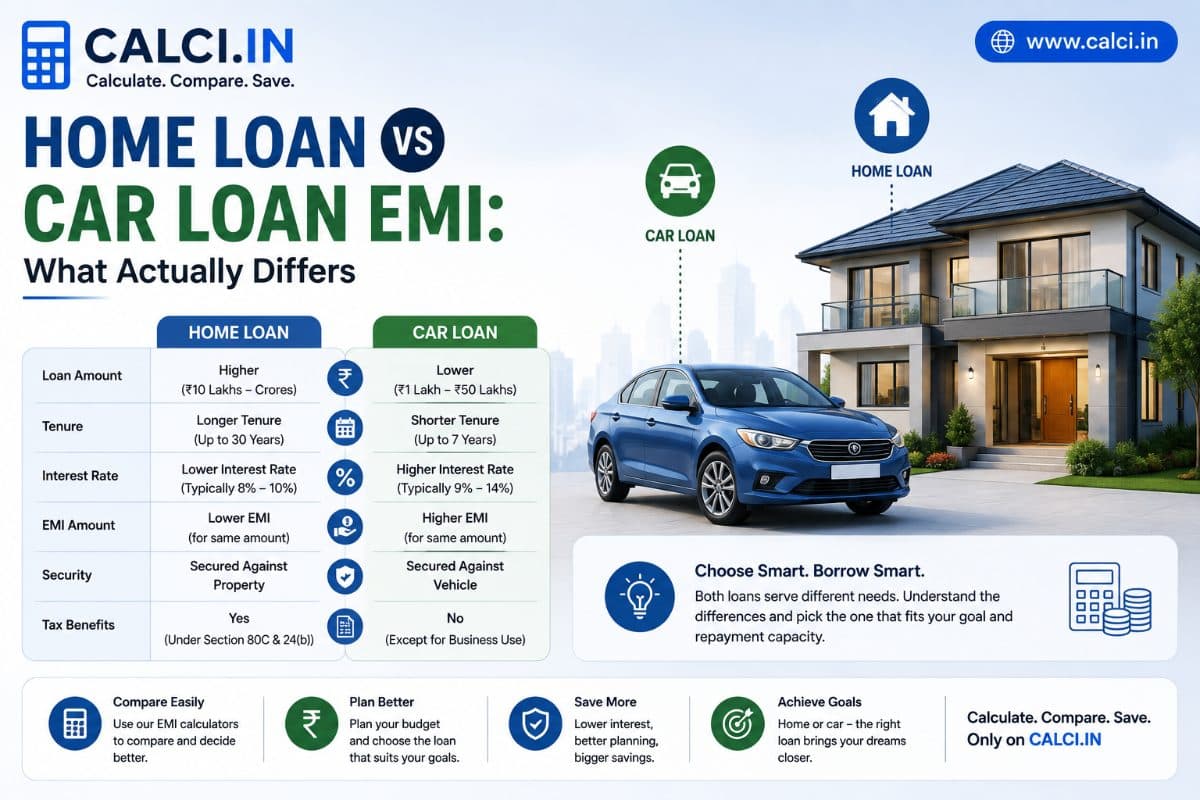
| Home loan | Car loan | |
|---|---|---|
| Typical rate | 8–9.5% | 9–14% |
| Tenure | Up to 30 years | 3–7 years |
| Loan to value | 75–90% | 80–90% of ex-showroom |
| Rate type | Almost always floating | Usually fixed |
| Prepayment penalty | Prohibited (floating, individual) | Common, 3–5% |
| Tax benefit | Old regime only, and now largely gone | None for personal use |
| Security | The property | The vehicle |
Two of those deserve a paragraph each.
Prepayment. Floating-rate home loans to individuals cannot carry a foreclosure charge — that is an RBI direction. Car loans are usually fixed-rate and commonly charge 3–5% of the outstanding. So the "prepay early" advice that is straightforwardly correct for a home loan needs checking on a car loan: the charge can outweigh the interest saved if the loan is nearly finished.
Rate type. A fixed car loan is genuinely fixed for its whole term, which is fine over five years. A floating home loan will move over twenty, and lenders usually adjust the tenure rather than the EMI. A rate rise you never noticed on your statement can quietly add years to the loan. Check the outstanding tenure after every rate change, not just the EMI.
What neither EMI includes
Home loan: stamp duty and registration at 5–8% of property value, processing fee, legal and valuation charges, property insurance, GST on under-construction property, then maintenance and property tax forever. Budget 8–12% of the property value in cash on top of the down payment, none of it financeable.
Car loan: road tax at 6–14% depending on state, registration, insurance at ₹25,000–60,000 in year one, accessories. The on-road price runs 10–15% above the ex-showroom figure in the advertisement.
And then the running costs, which for a mid-size petrol car in an Indian city come to roughly ₹1.5 lakh a year before depreciation and before the EMI. Fuel, insurance, servicing, tyres, parking, tolls.
Depreciation in year one alone exceeds all of it.
Which to prioritise
If you are carrying both and have spare money, the ordering is not obvious and it should be.
Clear the car loan first — usually. It carries the higher rate, the shorter runway, and it is secured against something that is losing value while you pay for it. Check the foreclosure charge before you do; if it is 4% on a loan with eight months left, the arithmetic flips.
Then the home loan, where prepaying early is genuinely powerful because the interest is so front-loaded. ₹2 lakh prepaid in year two of a twenty-year loan saves around ₹6.4 lakh. The same amount in year fifteen saves under ₹1 lakh.
But before either: credit card debt at 40%-plus, then any personal loan. Prepaying an 8.6% home loan while carrying a card balance is the most common sequencing error in Indian personal finance, and it is expensive.
The uncomfortable question
There is a version of this comparison nobody wants to run, so here it is.
A house you live in is not an investment in the way people describe it. It is a place to live that also happens to appreciate, and it costs maintenance, property tax, insurance and the opportunity cost of the equity locked inside it. Whether buying beats renting depends on the price-to-rent ratio in your city, and in most Indian metros that ratio currently favours renting on the pure arithmetic.
A car is straightforwardly not an investment. It is a depreciating tool that buys you time and flexibility.
Which means the honest question for a car is not "can I get the EMI down" but "do I drive enough for this to beat taxis?" For anyone under about 8,000 km a year, ownership is frequently the more expensive option once depreciation is counted — and that calculation is worth doing once, properly, rather than assumed either way.
Nobody wants to hear that after they have chosen the colour. Better before.
Where these rules come from
The two loans differ less in their arithmetic than in the rules around them, and those rules are published rather than negotiable.
The Reserve Bank of India sets the framework for both: how a floating rate must be linked to an external benchmark, what a lender must disclose when it changes, and the restrictions on foreclosure charges that apply differently to a floating-rate home loan and a fixed-rate vehicle loan. The master directions index is where those provisions live.
The tax treatment is the other real difference, and it is set out on the Income Tax Department's portal: interest and principal on a home loan attract deductions that a car loan, for personal use, does not. That single asymmetry changes the effective cost of the two loans more than the headline rate gap does.
Both loans have their own calculator with a full amortisation schedule: the home loan EMI calculator and the car loan calculator. Before either, the loan affordability calculator shows what a lender will actually approve against your income and existing EMIs — and the prepayment calculator is worth running before you decide which loan to attack first.