

Prepay your home loan or invest? The ₹5 lakh question, with real numbers
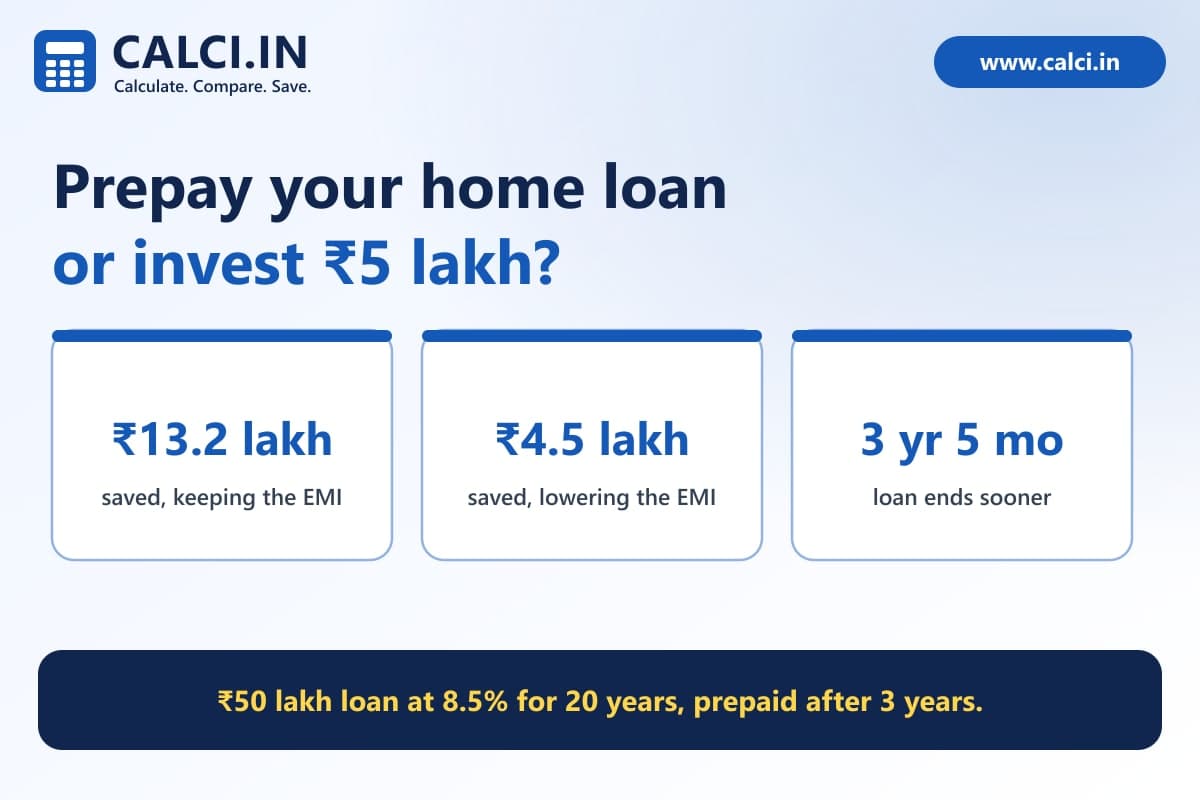
₹5 lakh against a ₹50 lakh loan at 8.5% saves ₹13.2 lakh of interest if you keep the EMI, but only ₹4.5 lakh if the bank cuts it. Timing matters more.
Calci Editorial · · 5 min read
You have ₹5 lakh sitting in a savings account and a home loan that costs 8.5%. Every guide offers the same two options, prepay or invest, and then picks a side with the confidence of someone who will not be paying the bill.
Let me not pick a side yet. Let me just put numbers on it, because the biggest swing in this decision is not between "prepay" and "invest". It is between two different ways of prepaying.
The loan
₹50 lakh, 8.5% a year, 20 years. The EMI is ₹43,391. Over the full term you would pay roughly ₹54 lakh in interest on top of the principal. Now you prepay ₹5 lakh three years in.
Choice one: keep the EMI, finish early
You tell the bank to leave the EMI at ₹43,391 and let the loan run out sooner. The loan prepayment calculator gives:
- Interest saved: ₹13,19,639
- The loan ends 3 years 5 months earlier, in 16 years 7 months
Choice two: lower the EMI, keep the term
You tell the bank to lower the EMI and keep the same end date. The EMI drops to ₹38,750, a saving of about ₹4,640 a month, and you save:
- Interest saved: ₹4,46,858
Same ₹5 lakh, same loan, same day. The first option saves nearly three times as much interest as the second. The second option feels better because your monthly outgo falls straight away, and many lenders apply it by default. If you are prepaying to save interest, ask for the first in writing.
The reason is simple. In the first option, the principal falls by ₹5 lakh and you keep paying the old EMI against a smaller balance, so more of every instalment is principal from the first month. In the second, you lower the instalment and spend the difference, which means less principal gets paid each month and the loan keeps charging interest on a larger balance for longer.
The second option can still be the right one, if the EMI is straining your budget. It just should not be the one you drift into.
Timing: when you prepay matters more than how much
Same ₹5 lakh, same loan, keep-the-EMI option, prepaid at different points:
| Prepaid after | Interest saved | Months removed |
|---|---|---|
| 6 months | ₹16,80,291 | 50 |
| 12 months | ₹16,03,691 | 48 |
| 36 months | ₹13,19,639 | 41 |
| 120 months | ₹5,71,382 | 24 |
₹5 lakh paid in the first year saves almost three times what the same ₹5 lakh saves in year ten. That is the part of this decision that is almost never discussed. Early in a loan, nearly all of each EMI is interest, so extra principal removed then is removed from the balance that will be charged interest for the longest time.
It also means the real question is not "should I prepay at all" but "have I got spare money in the early years, and what else could it do?"
Small and steady versus one big payment
You do not need ₹5 lakh in one go. An extra ₹5,000 every month from day one, with the EMI left alone, saves ₹13,89,250 and finishes the loan 4 years 5 months early, in 15 years 7 months. That is slightly more interest saved than the one-off ₹5 lakh after three years, from a habit of ₹5,000 a month that adds up to only ₹3 lakh over the first five years.
If you earn a bonus, a tax refund or an arrears payment each year, a lump sum once a year does much the same job.
Now put investing on the table
Here is the argument for investing instead. ₹5 lakh invested for 17 years at 12% grows to ₹34.3 lakh. At the loan's 8.5%, the same ₹5 lakh grows to ₹20.0 lakh. So if you can really earn 12%, investing beats prepaying by a wide margin.
I have two objections, and they are the whole argument.
One: the prepayment return is guaranteed and the investment return is not. Prepaying your loan earns you exactly the loan rate, 8.5% here, whatever the market does. Equity may deliver 12% over many years, or it may deliver 6%, and the year you need the money can be a bad one. To compare fairly, you need the investment to beat 8.5% after tax and after you have allowed for the risk, and a safe investment such as a fixed deposit rarely does.
Two: your loan rate is a hurdle you can see. The higher it is, the harder it is for any safe asset to beat it. At 9.5% prepaying is a very good return indeed; at 7% it becomes a close call.
A sensible rule: if the loan rate is above what you can earn safely after tax, prepay. If it is well below what you hope to earn on equity and you have a long horizon, you can split the money. Most people end up doing some of each, and that is fine.
The things that change the answer
- Your emergency fund. If prepaying leaves you with nothing in the bank, do not. A prepayment cannot be taken back out of a loan, while a savings balance can be spent. Keep six months of expenses first.
- Tax relief on interest. If you claim a deduction for home loan interest, your effective rate is lower than the rate on the sanction letter, and that shifts the balance towards investing. Work it out for your own tax situation.
- Prepayment charges. The Reserve Bank's rules, in force from 1 January 2026 for new and renewed loans, bar lenders from charging prepayment fees on floating-rate loans to individuals for non-business purposes. A fixed-rate loan can still carry a fee, and older loans follow their own terms, so read your loan agreement before you plan.
- Other debt. A credit card at 36% or a personal loan at 14% always comes ahead of a home loan at 8.5%. See which debt to pay first.
- How you will feel. A loan that ends four years sooner has a value that no spreadsheet captures, and it is a perfectly good reason to prepay.
What I would do with ₹5 lakh
If I had a loan at 8.5%, six months of expenses in the bank, no costlier debt, and a sudden ₹5 lakh, I would prepay a good part of it soon, choose the shorter term rather than the lower EMI, and put the rest into my regular investments. That is a view, not a rule, and your numbers may point elsewhere.
Whichever you choose, run your own loan through the prepayment calculator and your EMI through the EMI calculator, then compare it with what the same amount would do in the SIP calculator or the lumpsum calculator. The numbers will not decide for you, but they take the guesswork out of what you are deciding.