

How to split trip expenses fairly, with the fewest payments
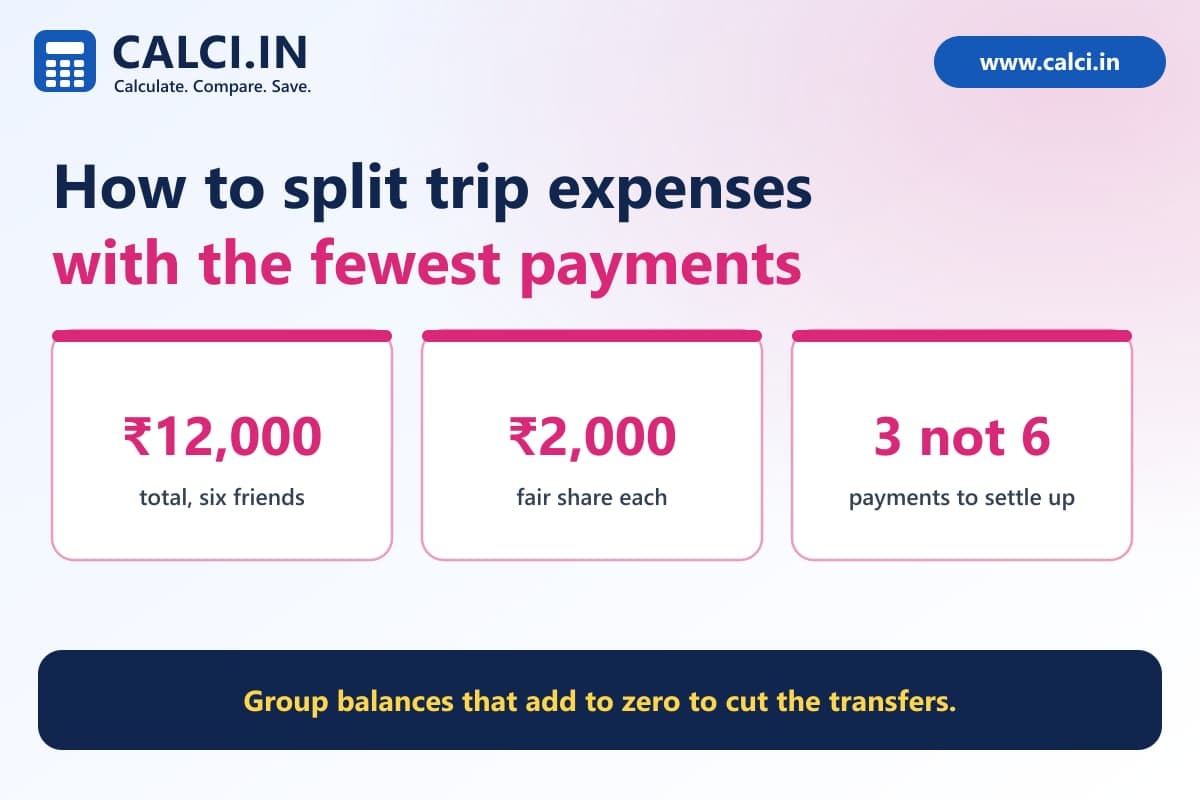
Six friends, ₹12,000 of costs, three of them owing money. Six UPI transfers would settle it, but three are enough. How the maths works and how to handle part-trip guests.
Calci Editorial · · 5 min read
Anyone who has organised a group trip knows the pattern. One friend pays for the hotel, another for the taxi, a third covers dinner and the petrol. Everyone means to sort it out later. A week afterwards the group chat is still full of "send me ₹800" and "wait, did I already pay you?"
Splitting costs fairly takes two steps: work out what each person should have paid, then work out who should pay whom. The first is simple. The second is where people make it harder than it needs to be, and where a little arithmetic cuts the number of transfers in half.
Step one: the fair share and the balance
Add up everything the group spent, divide by the number of people, and that is each person's fair share. A person's balance is what they actually paid minus their fair share:
- Positive: they paid more than their share and are owed money.
- Negative: they paid less and owe money.
- Zero: they are even.
All the balances in a group always add up to zero. Whatever one person is owed, others owe.
Here is a six-person trip with ₹12,000 of costs, so a fair share of ₹2,000 each:
| Person | Paid | Fair share | Balance |
|---|---|---|---|
| Asha | ₹5,000 | ₹2,000 | +₹3,000 (gets back) |
| Bilal | ₹1,000 | ₹2,000 | −₹1,000 (owes) |
| Carol | ₹0 | ₹2,000 | −₹2,000 (owes) |
| Dev | ₹3,500 | ₹2,000 | +₹1,500 (gets back) |
| Esha | ₹500 | ₹2,000 | −₹1,500 (owes) |
| Farid | ₹2,000 | ₹2,000 | 0 (even) |
Asha and Dev are owed ₹4,500 between them. Bilal, Carol and Esha owe the same ₹4,500. The totals match, as they must.
Step two: who pays whom
The lazy way is to have every debtor pay every creditor a proportionate part. Here that is 3 debtors × 2 creditors = 6 transfers, each a different small amount that someone has to calculate and send.
The smart way is to settle the debts with the fewest transfers. For this group, the trip expense splitter gives 3:
- Carol pays Asha ₹2,000.
- Bilal pays Asha ₹1,000.
- Esha pays Dev ₹1,500.
Check it: Asha receives ₹3,000 (her balance), Dev receives ₹1,500 (his), and Carol, Bilal and Esha each pay exactly what they owe. Farid does nothing, because he was even.
Half the transfers, round numbers, and nobody needs to hold a calculator while the bus waits.
Why 3 and not more: the idea behind it
Take everyone with a non-zero balance. If a set of k people has balances that add up to zero among themselves, they can settle with k − 1 payments, by having each debtor pay a creditor until everything is cancelled. So the fewer the number of payments, the more such self-contained groups you can find.
In this trip the five people with balances split neatly into two groups:
- Asha (+3,000), Bilal (−1,000), Carol (−2,000): adds to zero, so 2 payments.
- Dev (+1,500), Esha (−1,500): adds to zero, so 1 payment.
That is 2 + 1 = 3 payments. Without a second group the five people would need 4. The rule is:
Fewest payments = people with a balance − the largest number of zero-sum groups they can be split into
Finding that split by hand gets awkward when a group has eight or ten people, because there are many ways to combine balances. The splitter checks all the combinations (up to 16 people) and then pairs the largest debtor with the largest creditor inside each group. Settling this way never needs more payments than the number of people minus one, and it very often needs fewer.
Unequal shares: guests, couples and partial trips
Real trips are rarely equal. Three situations come up again and again.
A friend who joined for half the trip. Give them a share weight of 0.5. The splitter divides the total by the sum of the weights, not by the head count. With Aman, Bhavna, Chirag and Divya paying 8,400, 2,600, 900 and 0, where Divya joined for half the trip (weight 0.5), the total is ₹11,900 across 3.5 shares, so a full share is ₹3,400 and the half-share guest owes ₹1,700. The tool settles it in 3 payments: Chirag pays Aman ₹2,500, Divya pays Aman ₹1,700 and Bhavna pays Aman ₹800.
A couple. Put them in as one person with weight 2 if they split costs jointly, or as two people if you want to track each separately. The result is the same fair share per head.
Someone who skipped a cost. If one person did not take part in the safari, the rafting or the expensive dinner, the cleanest approach is to run the shared costs for the whole group first and then handle the optional one as a second small split among just the people who joined. Two calculations, each simple, are better than one tangled one.
Keeping the record without the drama
Settling is easier if the numbers are collected as they happen. Some habits that make the end of a trip painless:
- Write each payment down when it happens. A note on your phone is enough: who paid and how much.
- Decide the rule before the trip. Equal split, or by usage? Does the driver's petrol come out of a common pool? Agreeing on it first prevents arguments afterwards.
- Work in whole rupees. The splitter uses paise internally so the transfers always add up exactly, but you can enter round figures.
- Settle within a few days. Debts that run for weeks get forgotten, and the friend who is owed money often will not ask.
- Use one payment method. UPI makes each transfer instant. Sending the exact amount from the result avoids rounding.
If you are splitting the bill at a restaurant rather than over a trip, the tip calculator handles the tip and the per-person split, and the percentage calculator is handy for working out service charges. For a shared savings pot, such as a group gift fund or a holiday kitty, the savings goal calculator shows what each person needs to put in per month.
When splitting equally is not fair
Sometimes an equal split is the wrong answer. If one person is travelling on a much smaller budget, a shared expensive hotel or a pricey dinner may be well above what they would choose on their own. A group that wants to stay together has options:
- Agree a budget before booking, so that no one is surprised.
- Let those who choose the costly extras cover the difference.
- Use weights to reflect that some people share a room and others do not.
This is a conversation, not a calculation. The tool gives you the arithmetic for whatever rule you choose, but the rule itself is something friends decide together.
The short version
Add up the costs, divide by the number of shares to get each fair share, and note each person's balance (what they paid minus their share). Then settle with the fewest transfers by grouping balances that add to zero: for six friends and ₹12,000, that is 3 payments instead of 6. Use share weights for part-trip guests and couples, record costs as they happen, and settle within a few days.