

Avalanche vs snowball: which debt should you pay off first?
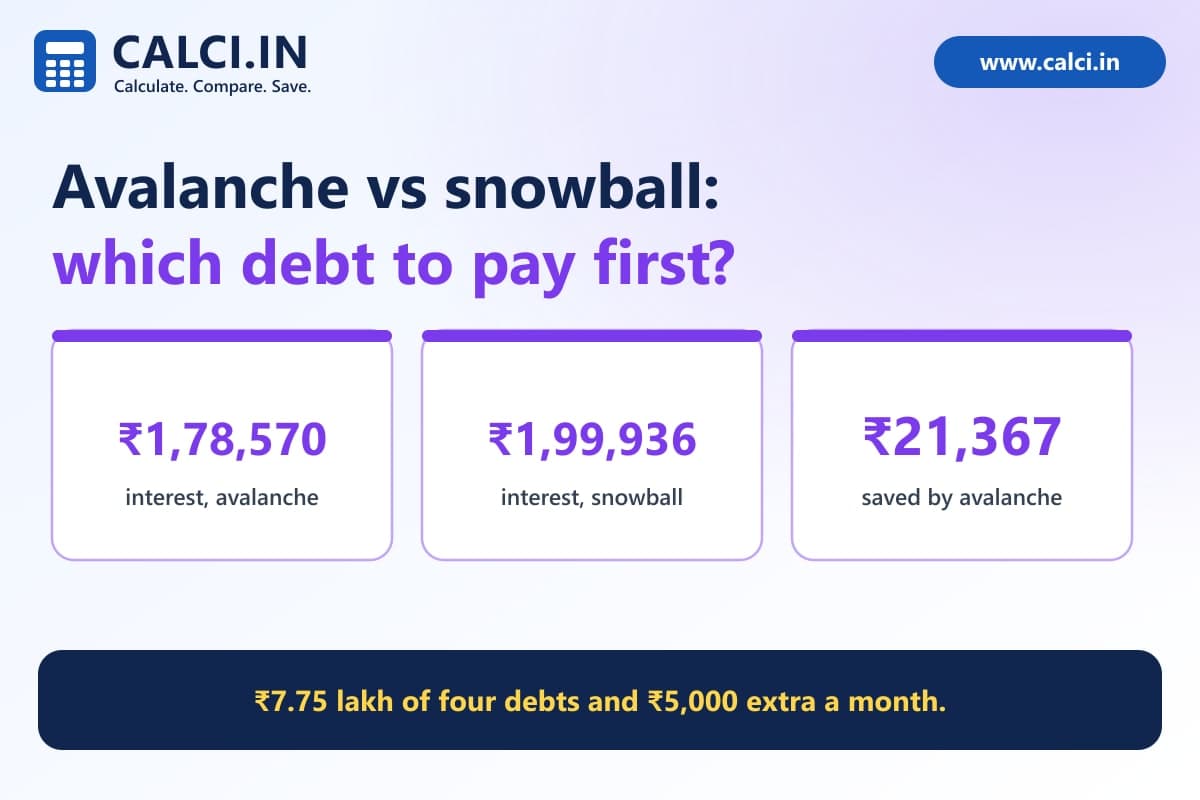
On ₹7.75 lakh of four debts and ₹5,000 extra a month, avalanche saves ₹21,367 over snowball. And if you pay only the minimums, the credit card never clears.
Calci Editorial · · 5 min read
Two ways to pay off several debts get argued about as if they were religions. One says to attack the debt with the highest interest rate first. The other says to knock out the smallest balance first and enjoy the win.
The first is called avalanche, the second snowball. Mathematically one of them always costs less. Practically, the difference is smaller than the shouting suggests, and there is a bigger problem hiding underneath both.
The four debts
Here is a realistic pile, the kind that builds up over a few years:
| Debt | Balance | Rate | Minimum a month |
|---|---|---|---|
| Credit card | ₹85,000 | 36% | ₹2,500 |
| Personal loan | ₹2,50,000 | 14% | ₹6,000 |
| Car loan | ₹4,00,000 | 9.5% | ₹9,000 |
| Gold loan | ₹40,000 | 10% | ₹2,000 |
Total owed: ₹7,75,000. Total minimums: ₹19,500 a month. Suppose you can add ₹5,000 on top, so ₹24,500 goes out every month in all.
Both methods do the same thing with that money: pay the minimum on every debt, put the extra on one target, and when it is cleared move the freed-up payment to the next. They differ only in which debt is the target.
Avalanche: highest rate first
The extra money goes to the highest rate first: the credit card (36%), then the personal loan (14%), then the gold loan (10%) and last the car loan (9.5%).
Using the debt payoff calculator on these four debts:
- Debt-free in 4 years 0 months
- Interest paid: ₹1,78,570
- Credit card cleared in month 15, gold loan in month 22, personal loan in month 35, car loan in month 48
The gold loan finishes before the personal loan even though it was not the target. It is small enough that its own minimum payments clear it, and every minimum is still being paid.
Snowball: smallest balance first
Order by balance: gold loan (₹40,000), credit card (₹85,000), personal loan (₹2,50,000), car loan (₹4,00,000).
- Debt-free in 4 years 1 month
- Interest paid: ₹1,99,936
- Gold loan cleared in month 6, credit card in month 20, personal loan in month 39, car loan in month 49
The gap
Avalanche saves ₹21,367 and finishes a month sooner. That is real money, close to a full month of everything you are paying out, and if you are purely a numbers person the choice is made.
But look at what snowball bought you for ₹21,367. The first debt was gone in month 6 instead of month 15, and two debts were gone by month 20 instead of month 22. For some people, an early win is the thing that keeps them paying. For others, it is a poor price for a few months of satisfaction.
My view: if you will stick with either plan, choose avalanche. The extra interest in snowball is a fee for motivation, and you should only pay it if you need it. If you know that watching a balance disappear is what keeps you going, ₹21,000 spread over four years is not an unreasonable price. What costs more than either is quitting in month 14.
There is also a middle road. Clear the one tiny debt first if it is tiny enough, because it is cheap in interest and frees a payment, and then move to avalanche. In this pile the gold loan is ₹40,000, and clearing it first costs very little extra.
The part that matters more: the credit card
Now try the same four debts with no extra money, only the minimums of ₹19,500. The calculator says: never.
The credit card has ₹85,000 at 36% a year, which is 3% a month. Interest alone is ₹2,550 a month, and the minimum payment is ₹2,500. The balance goes up every month. No order of repayment fixes that, because avalanche and snowball only decide where extra money goes, and here there is no extra money to place.
This is the real danger of unsecured card debt, and it is why the calculator reports the problem before it compares anything. About ₹50 more a month stops the card growing. Anything above that starts to clear it, and each rupee pays off a debt that costs 36%, which is a better return than any investment you will find.
If the extra is out of reach, lower the rate rather than the order:
- A balance transfer or a personal loan at a lower rate to replace the card. A personal loan at 14% to clear a card at 36% saves a great deal, as long as you do not run the card up again.
- Asking your lender to restructure. It is not always possible, but it costs nothing to ask.
- Selling something you do not need. Cash that clears a 36% balance is worth much more than the item.
Rules that hold either way
- Always pay every minimum. Missing one costs a fee and damages your credit score, which costs more than anything the strategy saves.
- Pick the target and stick to it for the whole plan. Skipping between debts defeats both methods.
- Move the freed payment on. When a debt is cleared, the whole of its payment goes to the next target. This is the "snowball" part, and it is what makes both plans accelerate.
- Do not take new debt while you are paying. It is the commonest way plans fail.
- Keep a small cushion. A month's expenses in the bank stops one surprise bill from landing on the card again.
What the calculator assumes
The calculator treats each debt as a loan with a fixed rate, charged monthly, with the minimum you give it. Real debts differ in small ways. A credit card's minimum usually falls as the balance falls, a car loan has a fixed EMI that the lender will not let you skip, and some loans charge for early closure. Check with each lender, and treat the result as a good estimate of how the two plans compare rather than a prediction to the rupee.
Put your own debts in the debt payoff calculator, with each balance, rate and minimum, then try a few amounts for the extra. For a home loan, the choice between prepaying and investing is a different one, covered in prepay your home loan or invest. To see what a single EMI looks like, use the EMI calculator.
The short version
On ₹7.75 lakh across four debts and ₹5,000 extra a month, avalanche (highest rate first) costs ₹1,78,570 in interest and snowball (smallest balance first) costs ₹1,99,936, a gap of ₹21,367. Choose avalanche unless you need the early win. The bigger risk is a card at 36%: if you pay only its minimum, the debt grows and no method rescues it.