

Break-even point for a small business: a tiffin service, worked out
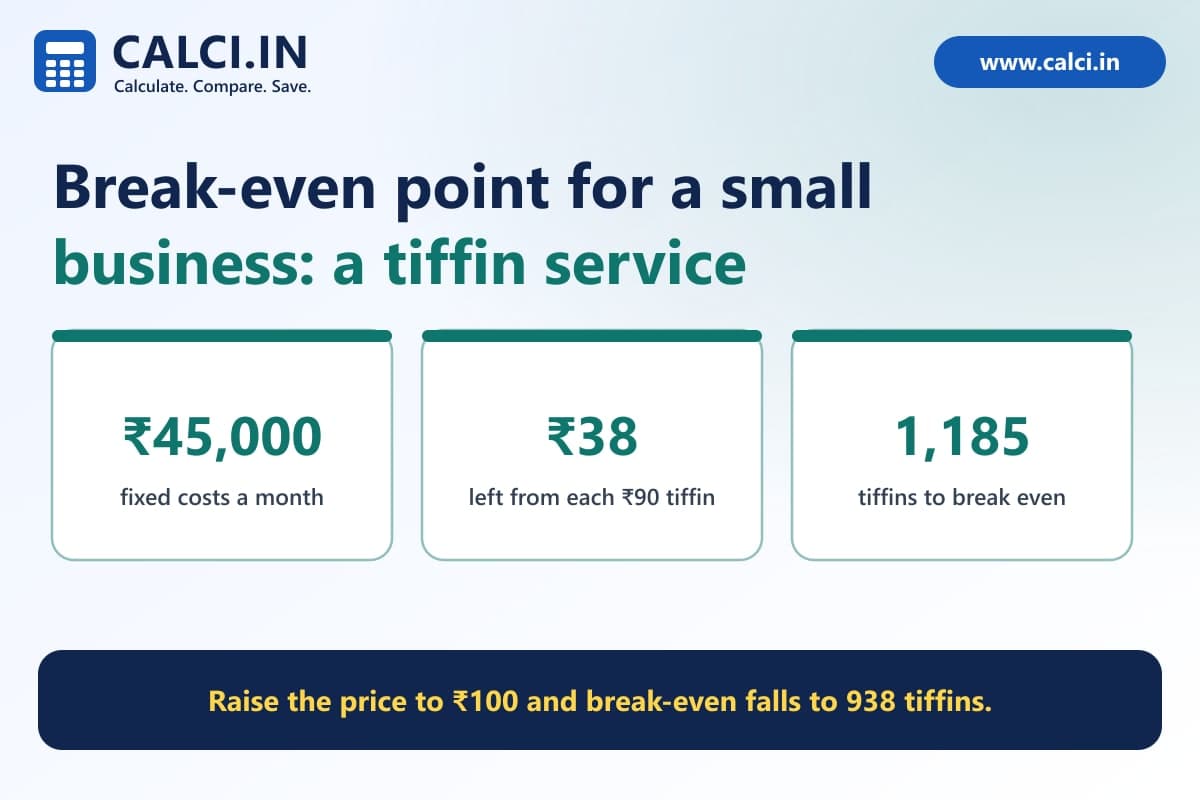
₹45,000 of fixed costs and ₹38 left from each ₹90 tiffin means 1,185 a month to break even. Raise the price to ₹100 and it falls to 938.
Calci Editorial · · 5 min read
Every new business owner asks the same quiet question in the first month: how many do I have to sell before I stop losing money? The honest answer is a number you can work out on the back of an envelope, and most people never do.
Let's do it for a small tiffin service, with figures a real one might have. Then change each input in turn, because the useful part is seeing which lever moves the answer the most.
The business
A home-kitchen tiffin service in a mid-sized city. Every month it pays:
- Kitchen and storage rent: ₹15,000
- One helper: ₹20,000
- Gas, electricity, phone and delivery bike running costs: ₹10,000
That is ₹45,000 of fixed costs. They arrive whether the kitchen cooks 10 tiffins or 1,000.
Each tiffin sells for ₹90. The food, packing and the delivery fee it costs per tiffin come to ₹52. That ₹52 is a variable cost: it only exists when a tiffin is made.
The one number that matters: contribution
Each tiffin sold leaves ₹90 − ₹52 = ₹38. This is the contribution: what is left from one sale after its own costs, available to pay the fixed bill and then become profit.
The break-even point is the number of tiffins whose contributions add up to the fixed costs:
Break-even units = fixed costs ÷ contribution per unit = 45,000 ÷ 38 = 1,184.2
You cannot sell 0.2 of a tiffin, so round up: 1,185 tiffins a month. That is about 40 a day over a 30-day month. At that volume revenue is ₹1,06,579, and every cost, fixed and variable, is exactly covered. Not a rupee of profit; not a rupee of loss.
The break-even point calculator does this arithmetic for any price and cost, and the step is worth doing on your own numbers before signing a lease.
Wanting a profit, not just survival
Break-even is the floor. Say you want ₹20,000 a month for yourself. Treat it as an extra fixed cost:
(45,000 + 20,000) ÷ 38 = 1,710.5, so 1,711 tiffins a month, or about 57 a day.
Going from 40 a day to 57 a day, an increase of 44%, is what it takes to turn "no loss" into "₹20,000 a month". Many small businesses run for months at 45 a day, call it a success, and never ask why there is no money to take out.
Lever one: price
The most powerful lever is also the one owners are most reluctant to pull. Same business, same costs, different price:
| Price per tiffin | Contribution | Tiffins to break even |
|---|---|---|
| ₹72 | ₹20 | 2,250 |
| ₹81 | ₹29 | 1,552 |
| ₹90 | ₹38 | 1,185 |
| ₹99 | ₹47 | 958 |
| ₹113 | ₹61 | 744 |
An extra ₹10, taking the price to ₹100, lifts the contribution from ₹38 to ₹48 and drops the break-even from 1,185 to 938, about 247 fewer tiffins, or 8 fewer a day. A ₹10 increase is 11% on the price, and it cuts the number you must sell by 21%.
A price cut works the same way in reverse, and much more harshly. A ₹18 cut to ₹72 leaves ₹20 of contribution, almost halving it, and the break-even nearly doubles to 2,250 tiffins, 75 a day, which a single kitchen and one helper probably cannot cook.
The question to ask before any discount or offer, then, is not "will it bring customers?" but "how many more customers does it have to bring to make up for it?" At ₹72 the answer is almost twice as many.
The honest limit is that a higher price may lose customers. That is a judgement about your market, and no calculator makes it. What the calculator tells you is how many customers you can afford to lose: raising the price to ₹100 pays for itself as long as you lose fewer than about a fifth of your volume.
Lever two: variable cost
Suppose vegetables and gas get dearer and the cost per tiffin rises from ₹52 to ₹58, a ₹6 increase. Contribution falls to ₹32, and the break-even rises from 1,185 to 1,407, an extra 222 tiffins a month. A 12% increase in the cost of making each tiffin raises the number you must sell by 19%.
That is why the cost of ingredients matters more than it feels like it does: it is multiplied by every tiffin.
Lever three: fixed cost
If the rent rises by ₹5,000, fixed costs go to ₹50,000 and the break-even moves to 1,316, up by 131 tiffins. A ₹5,000 rise in a fixed cost costs 131 tiffins, while a ₹6 rise in a variable cost costs 222. Both hurt. But only fixed costs stop mattering once you are past break-even, whereas variable costs keep taking their cut from every extra sale.
How safe are you? The margin of safety
Suppose you plan to sell 1,500 tiffins a month. Profit is 1,500 × ₹38 − ₹45,000 = ₹12,000. The margin of safety is how far sales can fall before profit hits zero: (1,500 − 1,185) ÷ 1,500, about 21%. If orders fall by more than a fifth, you are losing money.
A small business with a margin of safety under 10% is one slow month away from a loss, and owners in that position have little room to take a holiday. The tool shows this figure when you enter your planned sales.
What the model leaves out
A break-even sum is a simplification, and it is worth knowing where it bends.
- Costs are not always fixed or variable. A second helper becomes necessary at 60 tiffins a day, so fixed costs rise in steps. Check the break-even at each level.
- Your own pay is a cost. If the ₹45,000 does not include a salary for you, break-even is not the point at which you can stop worrying; it is the point at which the business has paid everyone but you.
- Not every tiffin sells at ₹90. Discounts, free trials and unpaid credit all shrink the contribution. Use the average price actually received.
- Cash and profit differ. If customers pay at the end of the month, you will need working capital to buy ingredients before the money arrives, even once you are above break-even.
- It is a monthly figure. Seasonal businesses should work it out for a year, not a month.
Using it before you commit
Before you sign a lease, hire someone or launch an offer, put the numbers in. Fixed costs, price and variable cost give you the volume you must reach, and how much each lever changes it. If the break-even is more than you can cook, serve or sell, the answer lies in the inputs, not in working harder. For turning a target margin into a price, read markup vs margin, and the profit margin calculator shows where each rupee of revenue goes.
The short version
With ₹45,000 of fixed costs and ₹38 left from each ₹90 tiffin, the tiffin service must sell 1,185 a month to break even and 1,711 to take home ₹20,000. A ₹10 price rise cuts the break-even by 21%, while a ₹6 rise in the cost of making a tiffin raises it by 19%. Know your number before you spend.