

How many matches in a league? Round-robin maths for organisers
Ten teams playing each other once need 45 matches over 9 rounds, and 90 if home and away. See the formula, the odd-team bye, and when a group stage beats a full league.
Calci Editorial · · 6 min read
If you run a local cricket tournament, a school sports day, an office football league or an esports ladder, you hit the same wall early. Someone says "let's have everyone play everyone", and nobody has any idea whether that means three weeks or three months.
The answer is a short formula, and once you have it you can plan dates, grounds, umpires and prizes in about five minutes. This post gives you the formula, a table for common sizes, the odd-team problem that catches people out, and the alternatives when a full league is too long.
The formula
In a round robin, every team plays every other team once. With n teams, each team plays n − 1 matches. Every match involves two teams, so the total is:
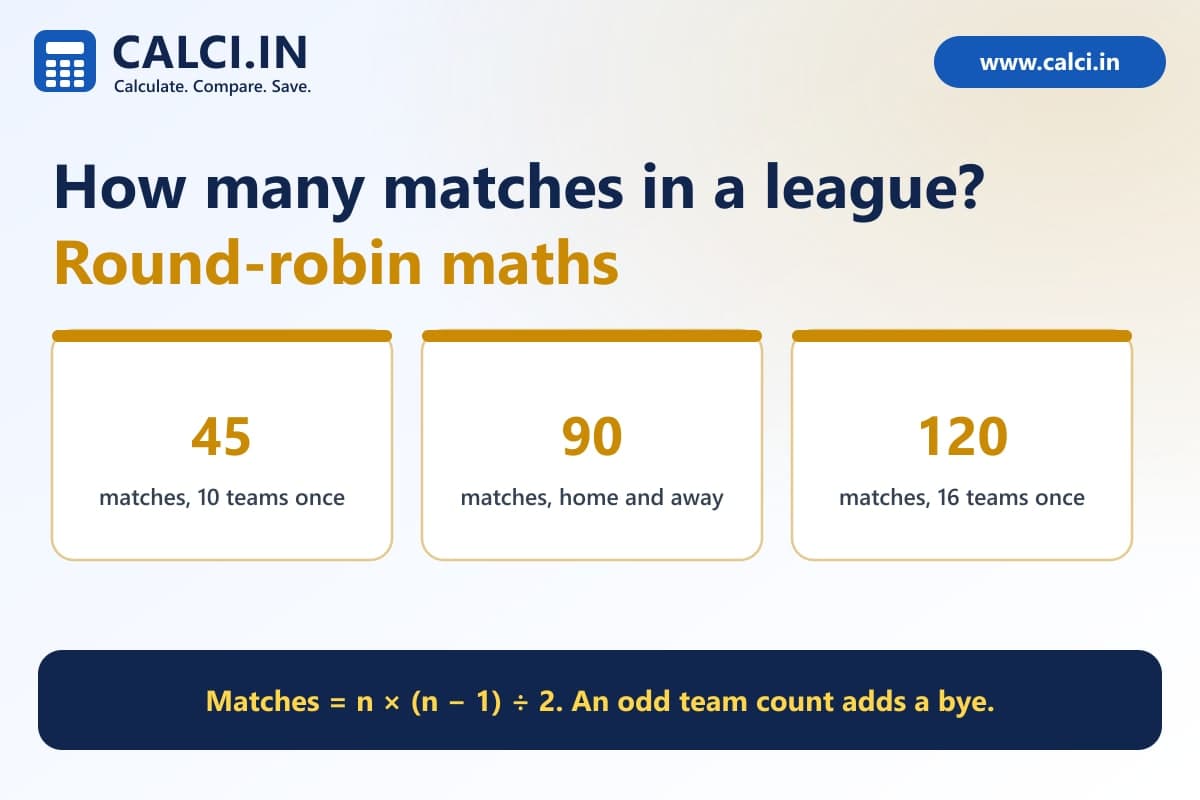
Matches = n × (n − 1) ÷ 2
For 10 teams: 10 × 9 ÷ 2 = 45 matches. That is each team playing 9 opponents (10 × 9 = 90 team-appearances), halved because each match has two sides.
If every pair plays twice (home and away, or two legs), double it: 10 teams make 90 matches.
A table for common sizes
| Teams | Once each: matches | Rounds | Home and away: matches |
|---|---|---|---|
| 4 | 6 | 3 | 12 |
| 5 | 10 | 5 | 20 |
| 6 | 15 | 5 | 30 |
| 7 | 21 | 7 | 42 |
| 8 | 28 | 7 | 56 |
| 9 | 36 | 9 | 72 |
| 10 | 45 | 9 | 90 |
| 12 | 66 | 11 | 132 |
| 16 | 120 | 15 | 240 |
Notice how quickly it grows. Going from 8 teams to 16 doubles the teams but multiplies the matches by 4.3: 28 to 120. The growth is roughly with the square of the number of teams, which is the reason big tournaments do not use a full league.
A round is a set of matches in which every team plays at most once, so all the matches in a round can happen on the same day or weekend. The number of rounds sets how long the tournament lasts, and the number of matches per round sets how many pitches or courts you need.
The odd-team problem
Eight teams split perfectly into four pairs, so every team plays in every round: 7 rounds of 4 matches. With nine teams, one team is always left over. It gets a bye, a round off.
The effect: 9 teams need 9 rounds, not 8. Each round has 4 matches and one resting team, and across the league every team gets exactly one bye. The total is 9 × 8 ÷ 2 = 36 matches.
| 8 teams | 9 teams | |
|---|---|---|
| Matches | 28 | 36 |
| Rounds | 7 | 9 |
| Matches per round | 4 | 4 |
| Byes | none | 9 (one team each round) |
A ninth team costs two more rounds, not one. If your tournament has a fixed number of weeks, adding or dropping one team can decide it. The fixture generator handles the bye automatically and marks which team rests in which round.
How the schedule is built
The method most organisers use is the circle method. Write the teams in two rows, fix one team in place, and rotate the others one step each round. In each round, the teams facing each other across the two rows play. After n − 1 rounds (for even n), every pair has met exactly once. For odd numbers, add a dummy "bye" team and the same trick works: whoever is paired with the dummy sits out.
It is easy to do on paper for 6 teams and awkward for 12, which is why people use a tool. The generator produces the fixtures for up to 32 teams, either once or home and away, and exports them as a CSV that opens in Excel or Google Sheets for sharing.
How long will it take?
Matches per round tell you how many playing areas you need, and rounds tell you how many sessions. If you only have one ground, you play one match at a time, and the total number of matches is the number of slots.
Take 10 teams with one ground and a T20 or a 40-minute football match:
- 45 matches, with a ground that can host two matches a day: about 23 playing days.
- With 5 grounds for the 5 matches in a round: 9 days, one round a day.
Add rest days, weather days and the final. A league of 12 teams (66 matches) on one ground is not a "two-week event". It is a season.
Alternatives to a full league
When 45 matches or 120 is too many, organisers use one of these:
Knockout. Lose and you are out. 16 teams need only 15 matches, since each match removes one team. It is fast but unforgiving, and half the teams play just one match.
Groups plus knockout. The most common compromise. For 16 teams in 4 groups of 4, each group is a mini-league of 6 matches, so 24 group matches, then quarter-finals (4), semi-finals (2) and a final (1): 31 matches against 120 for a full league. Two groups of 8 would be 56 league matches plus semi-finals and a final, 59 in all.
Single league, short. Cut the league to a half-season, playing only some opponents. It is quick but unfair unless every team faces a similar set of opponents.
Double round robin for few teams. For 4 to 6 teams, playing everyone twice gives a decent season and keeps luck down.
Each has a different trade-off between the length of the event, the fairness of the winner and the number of meaningful matches. A full league is the fairest way to find the best team, because everyone faces the same opposition, and also the longest.
Running the table
Once the fixtures are out, you need a way to rank the teams. A usual order is points first, then net run rate or goal difference, then head-to-head or wins. For cricket, the cricket points table maker turns a list of results into a table with points and net run rate, and the net run rate calculator checks any single figure. The worked example in how big a win you need to qualify shows how the last-round NRR decides places.
If you need a match-day timetable for the umpires, volunteers or the school, the timetable maker lays out the day.
Fair scheduling tips
- Balance home and away. In a double round robin, each pair should play once at each team's ground.
- Avoid the same team always playing first. Rotate time slots so no team always gets the morning match or the last evening one.
- Publish the whole schedule up front. Teams plan around dates, and changing fixtures later causes arguments.
- Plan the byes. In an odd league, tell teams when they rest. A bye in the last round is an advantage or a disadvantage depending on the table, so spread them.
- Keep spare dates. Rain and exams will move some matches, so leave room for them.
The short version
A round robin with n teams has n × (n − 1) ÷ 2 matches: 10 teams play 45 matches over 9 rounds, 90 if home and away, and 16 teams play 120. An odd number of teams adds a bye, so 9 teams need 9 rounds rather than 8. If the full league is too long, 4 groups of 4 plus a knockout gives 16 teams a tournament of 31 matches.