

How to calculate CBM and volumetric weight before you ship
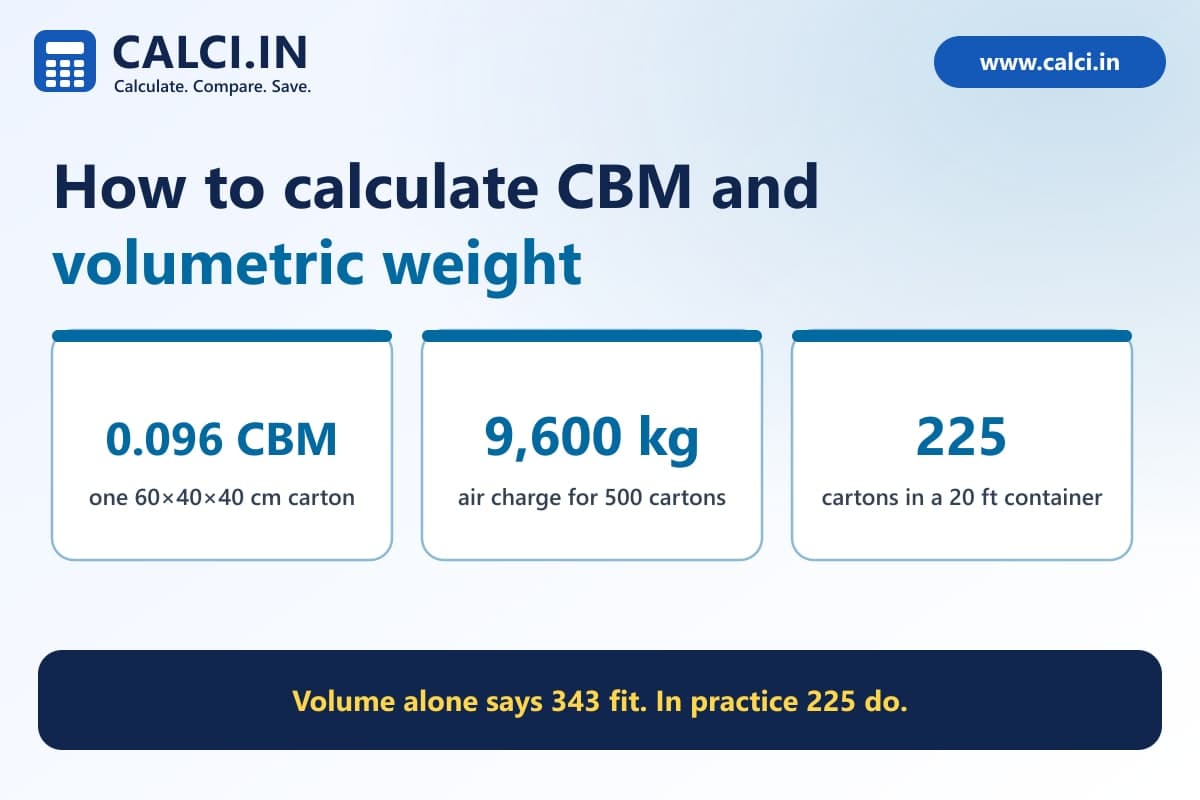
500 cartons of 60 × 40 × 40 cm are 48 CBM and 9,600 kg by air, yet only 225 fit in a 20 ft container. The three shipping numbers, worked out step by step.
Calci Editorial · · 6 min read
Every freight quote asks the same few questions: how many cubic metres, how heavy, and by air or by sea? A new exporter, a small online seller or someone moving a shop's stock often gets the quote back and finds a number nobody explained. "Chargeable weight 9,600 kg" for a shipment that weighs 6,000 kg is a typical shock.
None of it is difficult. There are three numbers, and each comes from a short formula. This post builds all three for one realistic order, then shows the mistake that costs the most money: assuming that volume equals what fits.
The order
500 cartons. Each is 60 cm long, 40 cm wide and 40 cm high and weighs 12 kg when packed. Think of garments, kitchenware or packed accessories. That is 6,000 kg of goods in total.
Number one: CBM (cubic metres)
CBM is the volume of the cargo in cubic metres. For one carton:
CBM = length × width × height (all in metres)
60 cm = 0.6 m, 40 cm = 0.4 m, so 0.6 × 0.4 × 0.4 = 0.096 CBM. For 500 cartons that is 0.096 × 500 = 48 CBM.
Two shortcuts to check yourself:
- In centimetres, multiply L × W × H to get cubic centimetres and divide by 1,000,000. Here 96,000 ÷ 1,000,000 = 0.096.
- In inches, divide cubic inches by 61,024 to get cubic metres.
If you work in cubic feet, 1 CBM is about 35.3 cubic feet, so 48 CBM is about 1,695 cubic feet. The CBM calculator takes centimetres, inches, millimetres or metres and shows both.
Measure the packed carton, not the product. Include the thickness of the box, any protruding handle and the pallet if one is used. A box that is 2 cm bigger each way is a quite different volume: 62 × 42 × 42 cm is 0.109 CBM, 14% more than 0.096, and on 500 cartons it is an extra 6.7 CBM.
Number two: volumetric weight (for air and courier)
Airlines and couriers sell space, not just weight. A box of feathers fills an aircraft hold as much as a box of the same size packed with metal, so they charge for whichever is larger, the actual weight or the volumetric weight.
Volumetric weight (kg) = L × W × H (cm) ÷ 6,000
(Some couriers divide by 5,000, which is stricter. The divisor is on your quote or the carrier's website. The standard air-cargo figure of 6,000 corresponds to 167 kg per cubic metre.)
For one carton: 96,000 ÷ 6,000 = 16 kg, against a real weight of 12 kg. Volumetric is bigger, so you are charged for 16 kg per carton. For 500 cartons that is 8,000 kg, not 6,000.
With a courier using 5,000: 96,000 ÷ 5,000 = 19.2 kg a carton, so 9,600 kg for the shipment, 60% more than the goods actually weigh.
Compare a dense product. If each carton weighed 25 kg instead, 25 kg is more than 16 kg, so the real weight is charged: 12,500 kg for 500 cartons. The rule is simply "the greater of the two", and the same carton can be charged either way depending on what is in it.
A way to know in advance: divide actual weight by volume. If a carton holds more than 167 kg per CBM (6,000 divisor) it is "heavy" and charged by weight. The 12 kg carton is 125 kg per CBM (12 ÷ 0.096), so it is a "light" cargo charged by volume. This is the usual position for garments, plastics, toys and packaging.
Number three: sea freight, W/M and what fits in a container
For sea freight there are two ways to ship.
LCL (less than container load): you share a container and pay per chargeable unit, which is the greater of CBM or tonnes of weight, under the "1 CBM = 1,000 kg" rule. Our 500 cartons are 48 CBM and 6 tonnes, so the chargeable quantity is 48 (CBM, being larger).
FCL (full container load): you pay for the container whether it is full or not. The Maersk internal volumes are about 33 CBM for a 20 ft, 67 CBM for a 40 ft and 76 CBM for a 40 ft high cube. So 48 CBM looks like it needs more than a 20 ft and fits in a 40 ft.
Here is where the arithmetic and the real world part company. Cartons are rigid boxes, and boxes leave gaps. Stacked straight, in the best way to stand the carton, the numbers are:
| Container | Volume | Cartons that fit | Containers for 500 |
|---|---|---|---|
| 20 ft | 33 CBM | 225 | 3 |
| 40 ft | 67 CBM | 500 | 1 |
| 40 ft high cube | 76 CBM | 600 | 1 |
Volume alone says a 20 ft could hold 343 of these cartons (33 ÷ 0.096). In practice it holds 225, about two thirds. The inside of a 20 ft is 5,896 mm long, 2,350 mm wide and 2,393 mm high, and a 60 × 40 × 40 carton does not divide those dimensions cleanly: in the straight-stacked layout above it leaves about 0.5 m of length unused, a strip across the width and some height at the top. A quote that assumes "33 CBM = 343 cartons" will leave you short by a container.
The 40 ft is a lucky match: exactly 500 cartons fit, which makes it a perfect, if unusual, case. The high cube adds 100 more because of the extra height. Compare the cost of a 40 ft container with an LCL booking for 48 CBM, because beyond roughly 15 to 20 CBM an FCL is often cheaper per unit as well as safer for the goods. That is a rule of thumb, not a quote.
Why your quote may be higher than your sum
- Pallets and wrapping. If cartons go on pallets, the pallet adds height (about 15 cm) and can waste space. Measure the loaded pallet.
- Rounding. Carriers often round CBM and weight up, to the next 0.1 CBM or the next 0.5 or 1 kg, depending on the rate card.
- Minimums. LCL often has a minimum charge, commonly 1 CBM or 1 tonne.
- Mixed cartons. If sizes differ, add each size's CBM separately and then sum. The tool handles one carton size at a time.
- Dead space inside the box. If a box is 40% air, either re-pack it or accept that you pay for the air.
Cutting the cost: what actually works
- Shrink the carton. Dropping each side by 2 cm (58 × 38 × 38) takes CBM from 0.096 to 0.0837, a saving of 13%. On air freight at 9,600 kg that is a charge reduction of more than a tonne.
- Change the shape to suit the container. A different carton size can load more efficiently. Try a few sizes in the calculator and look at "cartons that fit".
- Fill the weight limit. Heavy cargo that cubes out late (a dense product) fills the container's weight limit, so check both.
- Pick the mode on cost per kilo, not instinct. A 12 kg, 0.096 CBM carton costs far less per carton by sea. Air makes sense for high-value, urgent items.
If the goods are invoiced, remember GST and duty are on the value, not the volume. The GST calculator works out the tax on a price, and the profit margin calculator shows how freight per unit eats into your margin. For setting a selling price that survives the freight cost, see markup vs margin.
The short version
For 500 cartons of 60 × 40 × 40 cm at 12 kg each: 0.096 CBM a carton and 48 CBM in all; 16 kg volumetric weight a carton (8,000 kg for the order at a divisor of 6,000, or 9,600 kg at 5,000); and 225 cartons to a 20 ft container, not the 343 that volume suggests, while one 40 ft takes all 500. Measure the packed carton, charge the greater of real and volumetric weight, and check what actually fits before you book.