

Changing tyre size: how much speedometer error is safe?
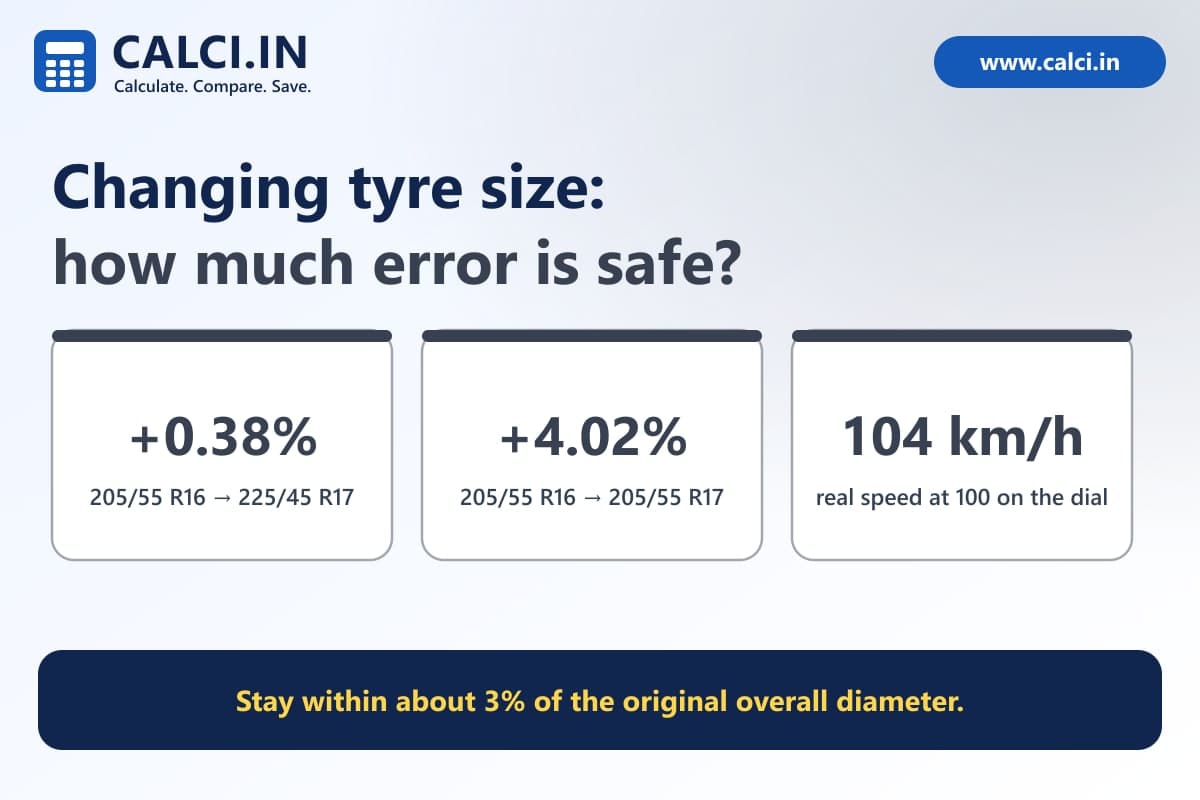
Moving from 205/55 R16 to 225/45 R17 changes diameter by just 0.38%. 205/55 R17 changes it by 4.0%, so 100 on the dial is really 104. The sums, size by size.
Calci Editorial · · 5 min read
Sooner or later a car owner looks at the alloy wheels on a showroom floor, or a dealer says "we don't have your size, but we have this one", and the question comes up: can I fit a different tyre?
The answer depends on one number more than any other: the overall diameter of the wheel and tyre together. If it stays close to the original, the speedometer, the odometer, the gearing and the electronic safety systems all keep working as designed. If it drifts, they do not. This post shows how to work out the number and what a few typical swaps do to it.
How to read a tyre size
Take 205/55 R16.
- 205 is the section width in millimetres, measured across the tyre.
- 55 is the aspect ratio: the sidewall height as a percentage of the width.
- R means radial construction.
- 16 is the rim diameter in inches.
The sidewall is then 205 × 55% = 112.75 mm. The overall diameter is the rim plus a sidewall at the top and another at the bottom:
Diameter = rim × 25.4 + 2 × width × aspect ÷ 100
For 205/55 R16: 16 × 25.4 = 406.4 mm of rim, plus 2 × 112.75 = 225.5 mm of rubber, which makes 631.9 mm.
The tyre size calculator does this for any two sizes and tells you the speedometer effect.
Why diameter decides everything
A wheel turns a certain number of times for every kilometre. The car counts those turns and converts them to distance and speed using the original tyre's circumference. A bigger tyre travels further per turn, so the car underestimates both. A smaller tyre does the opposite.
The error is simply the ratio of diameters:
Real speed = dial speed × (new diameter ÷ old diameter)
Take 205/55 R16 (631.9 mm) replaced with 205/55 R17 (657.3 mm). The ratio is 657.3 ÷ 631.9 = 1.0402. When the dial says 100 km/h, you are doing 104.0 km/h. The trip meter is wrong in the same direction: a true 100 km shows as about 96.1 km.
That sounds modest, but a car doing 104 in a 100 zone has a speeding ticket waiting, and the odometer is 4% short, which matters at service intervals and warranty limits.
Six common swaps, worked out
All against a dial reading of 100 km/h:
| Original | New size | Diameter change | Real speed | Within 3%? |
|---|---|---|---|---|
| 205/55 R16 (631.9 mm) | 225/45 R17 (634.3 mm) | +0.38% | 100.4 | Yes |
| 215/60 R16 (664.4 mm) | 235/45 R18 (668.7 mm) | +0.65% | 100.6 | Yes |
| 195/65 R15 (634.5 mm) | 205/60 R16 (652.4 mm) | +2.82% | 102.8 | Yes |
| 165/80 R14 (619.6 mm) | 175/70 R14 (600.6 mm) | −3.07% | 96.9 | No |
| 205/55 R16 (631.9 mm) | 205/55 R17 (657.3 mm) | +4.02% | 104.0 | No |
| 205/55 R16 (631.9 mm) | 215/60 R16 (664.4 mm) | +5.14% | 105.1 | No |
Look at the pattern in the first two rows. These are the classic "plus sizes": go up one inch of rim, widen the tyre by 20 mm and drop the aspect ratio by 10 points. The bigger rim is paid for by a thinner sidewall, and the diameter hardly moves.
Now the fifth row. Someone fits bigger wheels but keeps the same profile (205/55 on a 17 instead of a 16). The extra inch of rim goes straight into the diameter, and the result is 4% out.
The sixth shows a different trap: a "wider and taller" tyre on the same rim. 215/60 is wider and has a much deeper sidewall, so it is 5% taller. It may even rub the wheel arch.
The 3% rule
The common guideline among tyre fitters and manufacturers is that overall diameter should stay within about 3% of the original fitment. Inside that band, the speedometer, ABS and stability control are happy, the gearing is not noticeably changed, and the tyre will fit in the arch. It is a guideline, not a legal figure: it sits on top of the car maker's approved sizes, which are listed in the owner's manual and often on the door-pillar placard.
A few things to know about the number:
- The direction of the error matters. A smaller tyre makes the dial read higher than your true speed, which is the safer direction. A larger tyre does the opposite, and that is the one that gets drivers into trouble.
- Some speedometers already read high. Many cars are built to over-read by a few percent, so a bigger tyre cancels part of the error. Do not use this to justify a swap, and check against a GPS reading.
- Electronics assume the original size. ABS, traction control and some automatic gearboxes compare wheel speeds and expect a tolerance. Swaps beyond it can trigger warning lights.
- Other limits apply too. Load index and speed rating must meet or exceed the original. Rim width has to suit the tyre, and the tyre has to clear the suspension and arches at full lock.
Why not simply keep the same size?
Reasons people change size are mostly reasonable:
- Looks. Bigger wheels with low-profile tyres sharpen the look.
- Grip. A wider contact patch gives more dry grip, though also more road noise and often worse wet performance and aquaplaning resistance.
- Availability. The original size may be hard to find or expensive, and an equivalent size in the same diameter band is cheaper.
- Terrain. A taller sidewall rides better on bad roads, which is why some owners go to a higher profile on the same rim, as long as it stays within 3%.
The cost is on the other side of the ledger: thinner sidewalls give a harsher ride and make alloy wheels and tyres more prone to damage from potholes, and larger rims and tyres are dearer to replace.
A quick method you can use in the shop
- Read the current size from the sidewall: 205/55 R16.
- Ask the dealer for the size they propose.
- Put both into the tyre size calculator and read the diameter change and the speedometer figure.
- If the change is over 3%, ask for a different width or aspect ratio on the same rim, or compare with the manufacturer's approved list.
- Check the load index and speed rating match the original or better.
- After fitting, compare the dial with a GPS speed on a safe road to see what the car really reads.
A set of larger wheels and tyres is also a real expense. If you plan to pay for it in instalments, the EMI calculator shows the monthly cost, and how a car loan EMI differs from a home loan explains what the lender is charging you.
The short version
Overall diameter is rim × 25.4 plus twice the sidewall, and speedometer error is the ratio of the new diameter to the old. 225/45 R17 for 205/55 R16 changes it by 0.38%, but 205/55 R17 changes it by 4.02%, so 100 on the dial is really 104 km/h. Stay within about 3%, match load and speed rating, and use the car maker's approved sizes as the final word.