

GST explained: how tax stacks at every stage of a sale
The government collects ₹900 on a ₹5,000 sale that passed through three businesses. Not ₹1,620. Here is why, and the division that everyone gets backwards.
Calci Editorial · · 6 min read
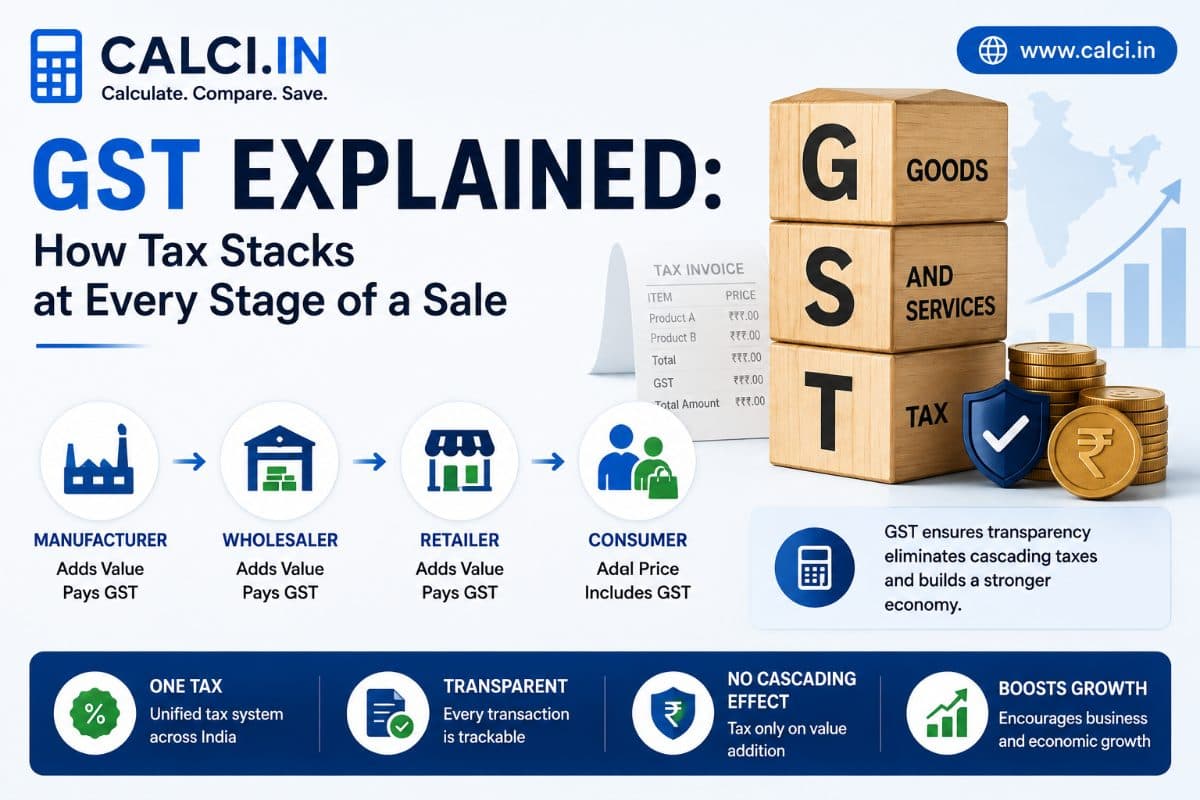
Here is a question that sounds simple and is not.
A timber merchant sells wood to a furniture maker, who sells a table to a retailer, who sells it to you for ₹5,000. GST is 18% at every stage.
How much tax did the government collect?
Most people say ₹1,620 — 18% charged three times, on ₹1,000, ₹3,000 and ₹5,000.
The answer is ₹900. Exactly 18% of the final price, once.
Follow the money
| Stage | Buys for | Sells for | GST charged | Credit claimed | Pays government |
|---|---|---|---|---|---|
| Timber merchant | — | ₹1,000 | ₹180 | ₹0 | ₹180 |
| Furniture maker | ₹1,000 | ₹3,000 | ₹540 | ₹180 | ₹360 |
| Retailer | ₹3,000 | ₹5,000 | ₹900 | ₹540 | ₹360 |
| Total | ₹900 |
Each business collects GST from its buyer and claims back the GST it paid its own supplier. It hands over only the difference — the tax on the value it added.
Hence "value added tax". The name is a description of the mechanism, not marketing.
The whole ₹900 is ultimately paid by you, the final consumer, because you are the only person in the chain who cannot claim it back. Everyone before you was a collection point.
What it replaced, and why it mattered
Before 2017 India ran excise, VAT, service tax, CST, octroi, entry tax and several more, layered on top of each other with no credit flowing between them.
Tax was charged on tax. The furniture maker's ₹180 became part of the retailer's cost, and the retailer's tax was calculated on a base that already included it. Every additional stage in a supply chain compounded the effect.
The practical consequence was that specialisation was penalised. A vertically integrated manufacturer paid less tax than three specialists doing the same work better, purely because there were fewer taxable handoffs. That is a strange thing for a tax system to encourage.
GST removed it. Whatever else is argued about the implementation, that structural fix is real.
The division everyone gets wrong
Now the practical bit, and the one that costs small businesses money every month.
Tip: The GST calculator does both directions — adding tax to a net price, and extracting it correctly from an inclusive one.
You have a bill for ₹11,800 including 18% GST. How much of that is tax?
The instinct is to take 18% off ₹11,800, which gives ₹2,124.
That is wrong by ₹324.
The correct working is a division:
base = total ÷ (1 + rate)
11,800 ÷ 1.18 = 10,000
tax = ₹1,800
The 18% was charged on ₹10,000, not on ₹11,800. Reversing a percentage means finding the base, not applying the same percentage to a larger number.
And the error is always in the same direction — always overstating the tax:
| Rate | Inclusive price | Correct tax | Subtracting instead | Overstated by |
|---|---|---|---|---|
| 5% | ₹10,500 | ₹500 | ₹525 | ₹25 |
| 12% | ₹11,200 | ₹1,200 | ₹1,344 | ₹144 |
| 18% | ₹11,800 | ₹1,800 | ₹2,124 | ₹324 |
| 28% | ₹12,800 | ₹2,800 | ₹3,584 | ₹784 |
Anyone filing returns from inclusive prices by subtracting is overstating their output tax and paying more than they owe. Every month.
Shortcut worth memorising: at 18%, the GST in an inclusive price is the total divided by 6.56. Or just divide by 1.18 and subtract.
CGST, SGST, IGST
Three components, and which you charge depends on where the supply goes — not where either party is registered.
Within a state: splits equally into CGST (central) and SGST (state). 18% becomes 9% + 9%.
Between states: a single IGST at the full 18%, collected centrally and apportioned to the destination state later.
The total is identical. A customer paying ₹11,800 pays ₹11,800 either way. The split matters to the exchequer and to how credit is claimed, not to the price.
The bit that catches people: the place of supply decides it. For goods, generally where they are delivered. For most services, the recipient's location.
A Delhi consultant billing a Delhi client charges CGST plus SGST. The same consultant billing a Mumbai client charges IGST. Same desk, same laptop, different tax component.
Get this wrong and the invoice has to be reissued, because the customer cannot claim credit against the wrong component.
The rate is not your opinion
| Rate | Typical coverage |
|---|---|
| 0% | Fresh produce, milk, unbranded flour and grain, books |
| 0.25% | Rough diamonds |
| 3% | Gold, silver, jewellery |
| 5% | Packaged essentials, transport, small restaurants, economy air |
| 12% | Processed food, business class travel, some medicines |
| 18% | Most goods and services, telecom, financial services, IT |
| 28% | Luxury goods, tobacco, aerated drinks, large cars |
The rate follows the HSN code for goods or the SAC code for services. It is a legal classification, not a judgement — the same-looking product can attract different rates depending on packaging, branding or intended use.
Get it from the official rate finder before invoicing. A wrong rate is the most expensive invoice error to unwind, because it has to be corrected on both sides.
Registration is a real decision
Compulsory above:
- ₹40 lakh for goods in most states, ₹20 lakh in special-category states
- ₹20 lakh for services in most states, ₹10 lakh in special-category states
And compulsory regardless of turnover for inter-state supply, most e-commerce sellers, and anyone liable under reverse charge.
Below the threshold it is voluntary, and the right answer depends entirely on who your customers are.
Selling to businesses? Register. GST costs your customer nothing — they claim it back — and you gain your own input credit on rent, equipment and everything else. Registration is close to free money.
Selling to consumers? Registration adds 18% to your price with no offsetting benefit to the buyer. That is a real competitive disadvantage against an unregistered competitor, and it is why so many small consumer-facing businesses sit deliberately below the line.
The composition scheme offers a lower flat rate up to ₹1.5 crore, but it forbids claiming input credit and forbids issuing invoices that let your customer claim it. That makes it workable for a consumer business and unworkable for a B2B one.
Where credit actually breaks
The system depends on your supplier filing their return.
If they collect GST from you and never deposit it, your credit can be denied. You paid the tax, you have the invoice, and you cannot claim it.
This is why GST compliance ratings matter commercially and why large buyers check them before onboarding a vendor. It is also the most common unpleasant surprise for a small business that took a cheaper quote from a supplier who turned out not to file.
Check that a new supplier's returns are current. It takes two minutes on the portal and it is cheaper than finding out in an assessment.
Invoice mistakes worth avoiding
Charging CGST and SGST on an inter-state supply. Reissue required.
Rounding line by line. Round the total instead, or the invoice will not reconcile with your return.
Discounts given after the invoice. A discount shown on the invoice reduces the taxable value. One given later as a credit note is treated differently and requires the recipient to reverse their credit.
Missing HSN or SAC codes. Mandatory above specified turnover thresholds, and returns are rejected without them.
Cash-basis thinking. GST is due when the invoice is raised, not when the customer pays. A business with slow-paying customers funds its own GST liability, and that gap is what kills otherwise profitable small firms.
Where these rates come from
GST rates and rules change by notification, often mid-year, so a rate quoted in an article is only as good as its date.
The GST portal is the government's own service for registration, returns and the current rate finder. CBIC's GST site carries the notifications and circulars themselves, which is where a rate change is published before it reaches any summary.
If a rate in this post disagrees with a notification, the notification is right and this page is out of date. That is worth saying plainly rather than implying a calculator is an authority on tax law.
The GST calculator does both directions — adding tax to a net amount, and extracting it correctly from an inclusive price — and splits the result into CGST, SGST or IGST depending on the supply type. If you are pricing rather than invoicing, the markup and margin calculator covers the other calculation small businesses get backwards, and the profit margin calculator shows what is left after everything.