

Simple interest vs compound interest: why your money grows differently
Same principal, same rate, same thirty years. One ends at ₹4 lakh, the other at ₹17.45 lakh. Nothing changed except what the interest was calculated on.
Calci Editorial · · 5 min read
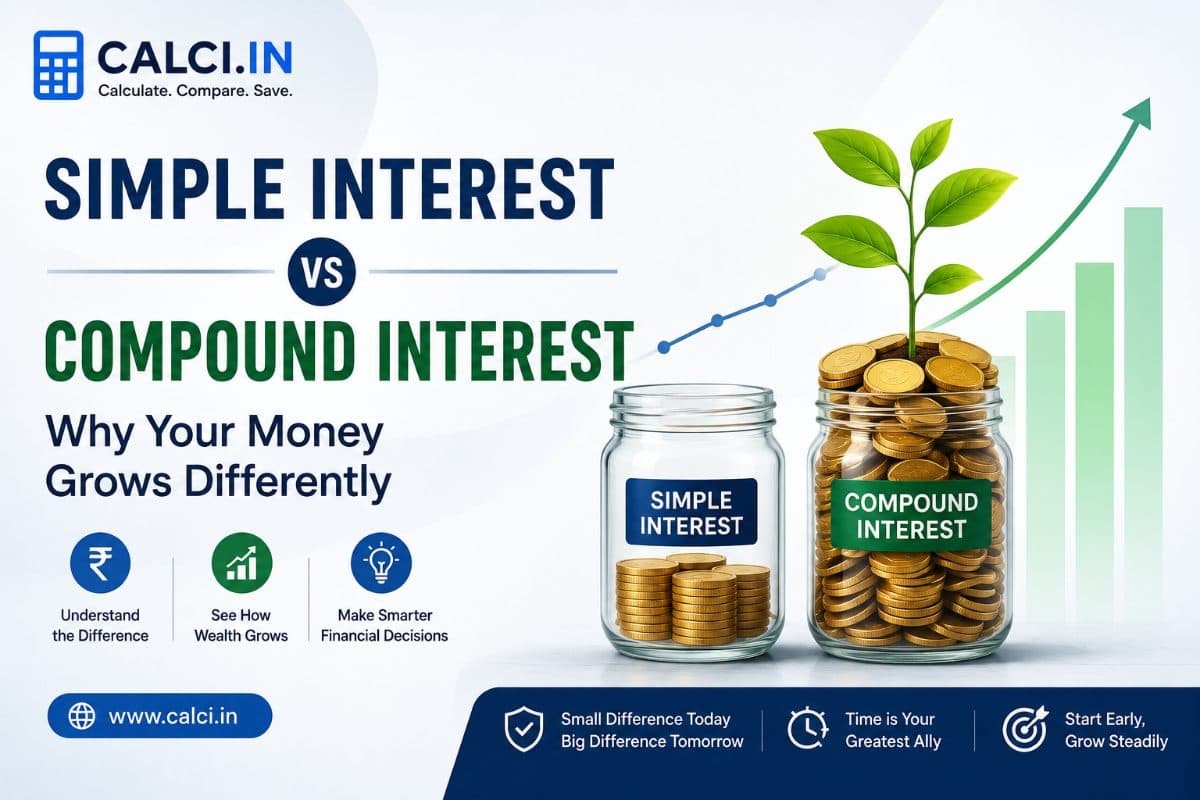
Two accounts. Same ₹1,00,000. Same 10%. Same thirty years.
One ends at ₹4,00,000. The other at ₹17,44,940.
The only difference is one word in the terms and conditions.
The difference in one sentence
Simple interest is calculated on the original amount, forever.
Compound interest is calculated on the original amount plus all the interest already added.
That is it. That is the whole thing.
Year one, they are identical — there is no accumulated interest yet to earn on. Year two they part company by ₹1,000, which nobody notices. Year thirty they are ₹13.45 lakh apart, which everybody notices.
Watch it happen
₹1,00,000 at 10%:
Tip: The compound interest calculator puts every compounding frequency side by side, so you can see what the frequency alone is worth.
| Years | Simple | Compound | Gap |
|---|---|---|---|
| 1 | ₹1,10,000 | ₹1,10,000 | ₹0 |
| 5 | ₹1,50,000 | ₹1,61,051 | ₹11,051 |
| 10 | ₹2,00,000 | ₹2,59,374 | ₹59,374 |
| 20 | ₹3,00,000 | ₹6,72,750 | ₹3,72,750 |
| 30 | ₹4,00,000 | ₹17,44,940 | ₹13,44,940 |
Look at the simple column. It adds ₹10,000 every year, forever. Straight line.
Now the compound column. Year one it earns ₹10,000. Year thirty it earns ₹1,58,631.
Nothing accelerated. The rate was 10% throughout. What grew was the number that 10% was applied to.
That is the entire mechanism, and it is why compounding is described as slow and then sudden. It is neither. It is perfectly steady, and the base it is steady on keeps getting bigger.
Where you actually meet each one
Most financial products compound. The ones that do not are worth knowing about, because they are usually being presented as if they do.
Compound, and you benefit: bank fixed deposits (quarterly), recurring deposits (quarterly), PPF (annually), EPF (annually), mutual funds, anything reinvested.
Compound, and you pay: credit cards (monthly, brutally), all EMI loans, gold loans.
Simple, and it is fine: deposits under a year, interest on delayed tax payments, some bridging arrangements.
Simple, and someone is hoping you do not notice: flat-rate car loans, personal loans from smaller lenders, chit funds and cooperative schemes quoting returns.
That last category is the one to look out for.
The flat rate trick
A dealer quotes you "8% flat" on a five-year car loan. It sounds cheaper than the bank's 14%.
It is not. It is very slightly more expensive.
Flat rate charges interest on the entire original amount for the entire term, no matter how much you have repaid. On a ₹6,00,000 loan you pay interest on six lakh in the final month, when you actually owe about fourteen thousand.
The conversion is roughly 1.8 times:
| Flat rate quoted | What it really costs |
|---|---|
| 5% | 9.2% |
| 7% | 12.5% |
| 8% | 14.1% |
| 10% | 17.3% |
| 12% | 20.3% |
Both numbers are called "the interest rate". Only one of them is comparable to what a bank quotes.
Ask for the reducing-balance rate. Or ask for the annual percentage rate, which lenders in India must disclose. If the conversation gets vague at that point, you have learned what you needed to.
Compounding frequency matters less than you think
This surprises people who have read that daily compounding is much better.
₹1,00,000 at 10% for ten years:
| Compounding | Value | Effective rate |
|---|---|---|
| Yearly | ₹2,59,374 | 10.000% |
| Half-yearly | ₹2,65,330 | 10.250% |
| Quarterly | ₹2,68,506 | 10.381% |
| Monthly | ₹2,70,704 | 10.471% |
| Daily | ₹2,71,791 | 10.516% |
Yearly to daily is worth ₹12,417 over a decade — about 4.8%.
Going from 10% to 10.5% with plain annual compounding achieves nearly the same thing.
Which means: compare products on their effective annual rate, not on the nominal rate and frequency separately. A 10.4% deposit compounded annually beats a 10.2% one compounded monthly, and the headline numbers suggest the opposite.
The theoretical ceiling — continuous compounding — gives ₹2,71,828. Daily is already within ₹37 of it. There is nothing left in frequency.
The rule of 72
Divide 72 by the rate to get the doubling time.
At 12%, six years. At 8%, nine. At 6%, twelve.
It is accurate to within a couple of months across the range that matters, and it is worth carrying because it converts any claim into something you can sanity-check.
"Triple your money in three years" implies 44% a year. "Double in five years" implies about 14.4%, which is plausible for equity and not plausible for anything described as guaranteed.
Somebody quoting you an absolute return over an unstated period is usually quoting a long one.
The direction nobody mentions
Compounding does not care which way the money is flowing.
An Indian credit card charging 3.5% a month is not charging 42% a year. Monthly compounding makes it 51.1%.
A ₹1,00,000 balance, untouched, becomes ₹1,51,107 after a year and ₹2,28,333 after two.
Pay only the 5% minimum and the balance outlives most cars.
This is why clearing a card balance is the highest-return thing available to almost anyone. A guaranteed, tax-free 51%. No investment on earth offers that, and people carrying card debt while running a SIP have the priority backwards.
The same logic applies to fees. An expense ratio of 1.5% against 0.5% on ₹10 lakh over thirty years at 12% gross is a difference of about ₹62 lakh — ₹2.62 crore against ₹2.00 crore. One percentage point, compounded, for thirty years.
And to inflation
At 6% inflation, prices double every twelve years. Money kept still halves in value on the same schedule.
Which is why a nominal return means nothing on its own. A 7% fixed deposit, taxed at 30%, against 5% inflation, produces a real return of roughly zero. The balance grows. What it buys does not.
For anything held longer than a few years, the number to model is the real return — nominal minus inflation. It is smaller, less impressive, and the only one that predicts anything.
The thing that actually matters
Across every table above, the variable doing the most work is time, not rate.
₹1,00,000 at 10% for thirty years gives ₹17.45 lakh. The same amount at 12% for twenty-five years gives ₹17.00 lakh.
Better rate. Five fewer years. Slightly worse result.
Starting earlier beats choosing better, and it is the only one of the two you can be certain of doing.
Where these rules come from
Which of the two applies to you is not a preference. It is set by the product and, for regulated products, by the regulator.
The Reserve Bank of India publishes the directions governing how interest is charged and compounded on bank deposits and on loans, including the compounding frequency a lender must disclose. For small savings, the National Savings Institute publishes the rate and the compounding basis for each scheme — PPF compounds annually, and that single fact is worth more than any comparison table.
A rate quoted without its compounding frequency is incomplete, and the gap between two products quoting the same rate is usually hiding in that missing word.
Run your own figures through the compound interest calculator — it shows frequency side by side, which is where most of the confusion lives. The simple interest calculator covers the flat-rate cases, and if you are trying to work out what a regular monthly amount becomes, the SIP calculator handles that shape instead.